

the genocidal terrorism that the State of Israel has
been exercising against the Palestinian People.
Recommended music videos for initiation to classical music


George Frideric Handel ( 1685-1759) was born in Halle , Germany. A naturalized British citizen, he is one of the leading figures in the history of music and, certainly, of the Baroque period . Of his abundant musical output, the oratorio Messiah stands out as one of the masterpieces of all time . As a child, he began receiving lessons in harmony and counterpoint from Friedrich Zachow , the organist of Halle , with whom he also learned to play the oboe, violin, and organ. At the age of 18, he moved to Hamburg, where he wrote his first two operas. After three years, he traveled to Florence and then to Rome . In 1710, he returned to Germany and from there to London, where he settled for the rest of his life. Despite the complete silence with which he protected his privacy, his homosexuality seems clear. He died at the age of 74 at his home.
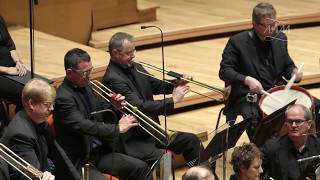
Music for the Royal Fireworks or Fireworks Music is an orchestral composition by George Frideric Handel from 1749. It was commissioned by George II of Great Britain to accompany the fireworks display that took place in Green Park, London , on April 27, 1749. The occasion was the celebration of the end of the War of the Austrian Succession and the signing of the Treaty of Aix-la-Chapelle .
The work is structured in five movements, of which we present the last two today: IV (0'07") LA RÉJOUISSANCE (THE JOY) This is one of the suite's most brilliant and triumphant movements, conveying celebration, victory, and royal magnificence. Written in D major , a key associated in the Baroque period with the majestic and heroic, its rhythm is lively and marked, with strong accents and prominent use of brass instruments (trumpets and horns), reinforcing its ceremonial character. It represents the public exaltation of power and the peace achieved after the war. V (2'17") MENUET (MINUET) This is an elegant and restrained French court dance that contrasts with the grandeur of "La Réjouissance." Of noble, refined, and balanced character, it is written in triple meter (3/4), typical of the minuet , and at a moderate tempo, with symmetrical phrases that place less emphasis on martial elements and more attention on grace and decorum. Handel includes two minuets in the work, sometimes performed as Minuet I (2:17) and II (3:06), alternating orchestral colors. This movement evokes the atmosphere of the court and social order, while also serving as a moment of repose and elegance after the explosive energy of the other movements.
Today it is offered to us by the Academy of Ancient Music, led by its head, the British maestro Richard Egarr.
Ludwig van Beethoven (1770-1827), along with Bach and Mozart, forms part of the trio of giants of Western music. Born in Bonn , his Flemish father attempted to showcase him as a second Mozart , though this proved a notable failure. Despite this, from the age of nine, the organist Christian Gottlob Neefe captivated him with the study of Bach , whose influence he would always hold dear. In 1787, he moved to Vienna intending to study with Mozart , but his mother's death forced him to return to Bonn a few days later. After five years, he returned to Vienna , where he was able to study with Haydn and Salieri . However, his career as an excellent pianist was cut short by the deafness that struck him the following year, leaving him completely unable to play.
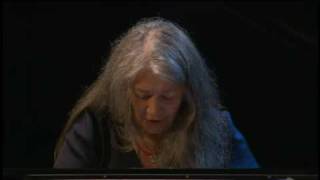
Ludwig van Beethoven 's Piano Concerto No. 2 in B-flat major, Op. 19 , was composed mainly between 1787 and 1789, although it did not reach its final form until its publication in 1795. The concerto became a showcase for Beethoven himself after his move from Bonn to Vienna . Beethoven was the soloist at its premiere on March 29, 1795, at the Burgtheater in Vienna , in a concert that marked his public debut. While the work as a whole follows the style of Mozart , there is a sense of drama and contrast that would be present in many of Beethoven 's later works. The concerto consists of three movements, of which we present the third today, a rondo that conveys the exuberance of the young composer.
Martha Argerich (1941) is a leading Argentine pianist of her generation. She gave her first public recital at the age of four and performed Mozart 's Piano Concerto No. 20 at seven. After her formal piano studies in Buenos Aires and Vienna , she undertook specialized masterclasses with eminent teachers. Throughout her career, she has received numerous national and international awards and accolades; she has made many recordings and has performed in the most prestigious concert halls, both as a soloist and under the baton of leading conductors.
Hugo Alfvén ( Stockholm , May 1, 1872 – Falun , May 8, 1960) was a Swedish composer, conductor, and violinist, who also distinguished himself as a painter and writer. He studied at the Royal Conservatory of Stockholm from 1887 to 1891, specializing in the violin. He also received private composition lessons from Johan Lindegren . He earned a living playing violin at the Royal Opera House and the Hovkapellet (Swedish Court Orchestra). From 1897 and for the next ten years, he traveled extensively throughout Europe . He studied violin technique in Brussels and conducting in Dresden . He subsequently became a violinist and professor of composition at the Stockholm Conservatory . In 1908, he was elected to the Royal Academy of Music . From 1910 he was director of music at Uppsala University , a position he held until 1939. He also directed the Orphei Drängar male student choir, with which he toured Europe . Alfvén is one of Sweden 's most important composers, along with Franz Berwald and Wilhelm Stenhammar . Of a romantic temperament, notably influenced by Wagner and Strauss , he wrote works for piano, chamber music, overtures, marches, five classically structured symphonies that showcase his skill as an orchestrator, symphonic poems, Swedish rhapsodies, vocal and theatrical music, lieder; ten cantatas for solo, chorus, and orchestra, two cantatas for male chorus and orchestra, a pantomime, incidental music, and film scores.
Catalogue of the works of Hugo Alfvén . His works are classified by their Opus number (from the Latin opus 'work'; op. abbreviation) which is a term used in music to catalogue the works of most composers since the 17th century .
“ Herd Maiden’s Dance ” – in Swedish “ Vallflickans dans ” – is an orchestral movement by Hugo Alfvén (1872–1960) that forms part of his suite The Mountain King, Op. 37 (also titled Bergakungen, “The King of the Mountain ”). The piece originates from Bergakungen , a ballet-pantomime in four movements that Alfvén composed between 1917 and 1922 and premiered in Stockholm in 1923. After the ballet production was withdrawn from the stage, Alfvén reduced some of the music to a four-movement symphonic suite , of which Herd Maiden’s Dance is the fourth and final movement.
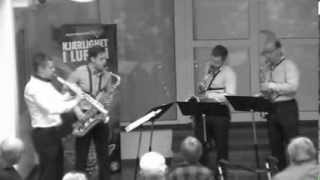
The title “ Herd Maiden’s Dance ” translates as The Shepherdess’s Dance or Dance of the Young Shepherdess , reflecting the pastoral and folkloric setting of the ballet’s plot. Its music is a lively and colorful orchestral dance-lyric piece, representing the young shepherdess’s role in the narrative. It is frequently performed in concerts as a standalone piece due to its energy, charm, and engaging orchestration. Herd Maiden’s Dance represents one of the most vibrant and celebrated scenes in the ballet, preceding the more dramatic episodes. This dance is one of the most popular and frequently performed sections of the suite The Mountain King and has even been arranged for other ensembles (symphonic band, flute ensembles, or saxophone quartet, as in the example presented here).
Structure . The piece is organized primarily in a ternary form (ABA'), with a brief introduction and a final coda: SECTION A (0'05"): This corresponds to the main theme, clearly folkloric and singable, with a lively, elegant, and rhythmic dance character. Its rhythm is marked, regular, and typical of a folk dance; this section represents the dance of the young shepherdess in a direct and luminous way. SECTION B (1'11"): This section is more lyrical and gentle, as befits its function as a contrasting section to the initial dance; here a more contemplative or dreamy moment appears, typical of Scandinavian Romantic nationalism. SECTION A' (2'17"): This is the recapitulation or return of the initial theme, with slight melodic or orchestral variations and a more affirmative and brilliant character than at the beginning. Coda (2`44``) fulfilling its closing function, in this case festive and conclusive with a cheerful dynamic that increases towards the end.
Today it is offered to us by The Nordic Saxophone Quartet in an arrangement by Johannes Thorell .

Patricia Malanca, born in Avellaneda, Argentina , is a prominent contemporary tango singer-songwriter and performer in the Buenos Aires music scene and the current tango landscape. Her work is characterized by its innovation within the genre, fusing it with other musical styles, exploring social themes, and contributing a personal and socially conscious perspective. In addition to her musical career, she has an academic background: she holds a degree in Psychology (University of Buenos Aires) and a master's degree in Public Management from FLACSO . She has released several original albums, including La Malanca (2013), Aunque nadie te vea nunca conmigo (2014) – a project adapting songs by Silvio Rodríguez to tango – and Bucles , 4 historias de amor y 11 tangos desesperados (Loops, 4 Love Stories and 11 Desperate Tangos). She was nominated for a Gardel Award for La Malanca . She was also nominated for a Latin Grammy for her album Bucles (2017) and won a Gardel Award in 2022 for her outstanding work and songs within contemporary tango.
She is considered a leading figure in contemporary tango, with a personal voice and style that engages with both social and poetic themes. Her music often fuses tango with other rhythms and musical languages, giving voice to contemporary concerns (gender, literature, human experiences). She actively participates in national and international festivals and has toured Europe, Latin America, Asia, and Oceania . She has also hosted television programs and participated in cultural projects, in addition to her experience in artistic and cultural management within the public sector. In short, Patricia Malanca is an influential figure in contemporary tango who combines original compositions, critical thinking, and artistic exploration to broaden the horizons of the traditional genre.
“ Rencor ” is a traditional tango song of unclear authorship, performed by Patricia Malanca ; it is included on her album La Malanca (2013). On the album, the song appears as the third track, alongside other tangos and pieces from Malanca 's traditional and contemporary repertoire. The performance highlights the drama and emotional weight evoked by the title “Rencor,” a common theme in tango that explores intense feelings such as pain, betrayal, and melancholy.
Recommended classical music videos
Arcangelo Corelli (1653-1713) was an Italian Baroque violinist and composer. Born in Fusignano (province of Ravenna ), he studied violin in his hometown from childhood. In 1666, he traveled to Bologna , where he studied with Giovanni Benvenuti and Leonardo Brugnoli . Five years later, he settled in Rome , where he achieved extraordinary fame as a violinist while simultaneously perfecting his compositional technique. By 1700, he was first violinist and concertmaster at the Palazzo della Cancelleria , and in 1706 he was admitted to the Accademia della Arcadia . Today, he is considered one of the greatest precursors of the pre-Classical sonata and the quintessential representative of the concerto grosso . His music exerted a great influence on German composers, especially Bach and Handel .
Catalogue of Corelli's works . His works are classified by their Opus number (from the Latin opus 'work'; op. abbreviation) which is a term used in music to catalogue the works of most composers since the 17th century .
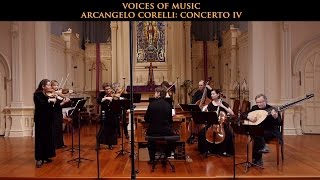
The 12 Concerti Grossi, Op. 6 , are a collection of twelve concertos composed by Arcangelo Corelli, probably in the 1680s, although they were not prepared for publication until 1714. The Concerti Grossi of Op. 6 were written for his own concerts, with Corelli himself playing the concertino . The orchestral ensemble consists of the concertino (a first violin, a second violin, and a cello concertante), the orchestra's 'grosso,' and the basso continuo provided by the harpsichord, which can be supplemented by the portative organ and lute. (Excerpted from LA Phil)
Arcangelo Corelli's Concerto in D major, Op. 6 No. 4 , belongs to the Baroque concerto grosso model, and its formal structure is quite representative of the late 17th-century Roman style . This concerto is a concerto grosso "da chiesa" (church concerto), which implies, on the one hand, four movements with alternating slow-fast-slow-fast tempos and, on the other hand, an absence of movements explicitly based on dances (unlike the concerto da camera ). Furthermore, Corelli clearly establishes the typical contrast of the concerto grosso: the Concertino, consisting of two violins and cello, and the Ripieno (tutti), consisting of the full string section plus basso continuo. This dialogue between the two groups is one of the formal pillars of the work, along with formal balance, a firmly established tonality ( D major ), and structural clarity within controlled counterpoint. Form based on contrasting sections, not on thematic development (unlike classicism ) with importance given to harmonic rhythm rather than extreme virtuosity
Structure : I (0'00") ADAGIO (D major) of a solemn and expressive character with homophonic texture and sustained chords, which fulfills an introductory function with a clear harmony that does not follow a strict closed form, but a free and rhetorical structure. - II (0'20") ALLEGRO. This is a lively and contrapuntal movement with imitative writing, close to the fugal style, alternating episodes of the concertino with interventions of the ripieno based on a principle of ritornello, although not yet fully codified as in Vivaldi . - III (3'30") ADAGIO. It is a short and lyrical movement with expressive contrast to the preceding Allegro ; of a lighter texture and with emphasis on the melodic discourse with the function of transition and harmonic rest. - IV (5'03") ALLEGRO and CODA (6'08") Energetic final movement with regular rhythm and greater prominence of the tutti ; All of this with a more homophonic writing style, with contrasting episodes and an affirmative ending in the main key.
Today it is offered to us by the San Francisco early music instrumental ensemble Voices of Music.
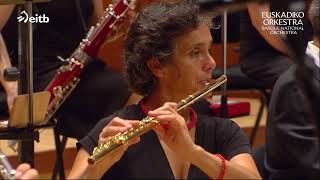
Johannes Brahms (1833-1897), born in Vienna where he spent most of his life, was the most conservative composer of Romanticism, in contrast to the progressive current led by Liszt and Wagner . His music is firmly rooted in the compositional structures and techniques of the Classical masters, and its formal structures faithfully follow Classical patterns, although it incorporates elements of Romanticism and popular music. The diligent and highly constructed nature of his works served as a starting point and inspiration for a generation of later composers; embedded within his meticulous structures are profoundly Romantic motifs. An eminently perfectionist, he wrote for piano, chamber ensembles, symphony orchestra, solo voices, and choir. It was Hans von Bülow who coined the term "the three Bs," referring to Bach , Beethoven , and Brahms as the three main pillars of music history .
Brahms' Symphony No. 3 in F major, Op. 90, was composed in 1883 in Wiesbaden and premiered the same year in Vienna . Generally speaking, it is a more lyrical, focused, and introspective symphony than his First and Second Symphonies, distinguished by the motivic unity between movements, a serene and restrained ending rather than a triumphant one, and a balance between classical tradition (form) and romantic idiom (harmony, expression). With its mature synthesis of classical form and romantic expression, Brahms ' Symphony No. 3 represents a work of great internal unity, both motivic and expressive, and an anti-rhetorical approach, where its strength, achieved through a restrained and balanced orchestration, lies in its depth and depth.
Its structure consists of four movements : I (0'13") ALLEGRO CON BRIO in F major in sonata form: a) Exposition (Immediate introduction without a slow prelude): First theme of a heroic, decisive, and rhythmically firm character with intensive use of syncopation and hemiola. Second theme of a lyrical, cantabile character, contrasting with the first theme; b) Development : Highly concentrated and dense, with fragmentation of the initial motif and frequent modulations and chromaticism; c) Recapitulation : Return of the first theme in F major ; the second theme also reappears in F major (classical arrangement). d) Short but energetic coda and reaffirmation of the initial heroic character. II (13'14") ANDANTE in ternary form (A–B–A'): a) Section A : Serene and noble theme, presented by woodwinds with a broad and balanced phrasing; b) Section B with modulations to minor keys and greater contrapuntal density; c) Section A'. Return of the initial theme, with timbral variations within a more contemplative character. A movement of repose and balance, without excessive drama. - III (22'04") POCO ALLEGRETTO (Also in ternary form (A-B-A) replacing the traditional scherzo ); a) Section A. Melancholic and cantabile theme begun by the cellos with a balanced, almost slow dance rhythm, and of a nostalgic character; b) Section B. Greater luminosity and melodic expansion with expressive contrast, although without an abrupt break; c) A'. Return to the initial intimate atmosphere with a softened texture. It is one of Brahms 's most lyrical movements. - IV (29'17") ALLEGRO – UN POCO SOSTENUTO in modified sonata form; a) Exposition: First theme in a gitado style, rhythmically incisive. Second theme more lyrical, in a major key and in clear emotional contrast; b) Dramatic but restrained development with rhythmic and harmonic intensification and the fragmented reappearance of the cyclical motif; c) Recapitulation with progressive resolution to F major and a decrease in tension. Coda. Unusually serene character and intimate ending, without triumphant grandeur.
Today it is offered to us by the Euskadiko Orkestra Sinfonikoa conducted by the American maestro Robert Treviño .

Philip Sparke (1951, London) is a British composer, conductor, and musician whose career has defined the modern standard for wind ensemble music. He trained at the Royal College of Music in London , where he studied trumpet, piano, and composition. During his student years, he became interested in concert bands , playing in the Conservatorium Wind Orchestra and forming his own brass band with other students. Sparke has acknowledged influences ranging from classical composers like Bach to the pop music of The Beatles and the jazz of Leonard Bernstein . Notably, he uses percussion not only as accompaniment but also as a fundamental melodic and rhythmic section that adds color and energy to the band. His catalog is vast, encompassing everything from extremely difficult competition pieces to educational works; all of them very demanding of the soloists, especially the brass instruments (euphoniums and cornets).
Harlequin is a contemporary work for euphonium ( enhanced brass instrument ) and, in some versions, piano, brass band, or concert band, composed by Philip Sparke , a British composer well-known for his contributions to the repertoire of brass and brass solo instruments. It was commissioned and dedicated to euphonium virtuoso David Childs , who premiered it in March 2005 with the BAYV band, conducted by Robert Childs (his father), during a concert at the All England Masters International Championship . The music draws its inspiration from the happy and sad masks of the Commedia dell'Arte —an Italian theatrical tradition in which the character of Harlequin is central—and reflects this emotional duality in its musical structure. The piece is divided into two contrasting movements: I (0'07") A SLOW BALLAD with a modal, expressive, and lyrical character. II (4'36") A FASTER and more frenetic MOVEMENT, showcasing technical virtuosity and contrasting energy. The work is designed as a showpiece , with prominent solo lines that display both expressiveness and technical prowess, as well as contrasting moods: the treatment of textures and styles reflects the dual nature of Harlequin —humor and melancholy—making the work musically engaging and dramatic. It demands a high level of technical ability, good musicianship, and stamina from the performer, especially in the fast movement. Harlequin has become a highly regarded work in the contemporary euphonium repertoire, frequently performed in competitions, recitals, and band concerts. Due to its difficulty, it is often chosen for advanced soloists or as a competition piece.
Today the Societat Musical de La Llosa de Ranes, led by maestro Rafa Grau, accompanies the euphonium player Sergio Garrido .
Judit Varga is a contemporary Hungarian composer born in 1979, known for her symphonic, chamber, and vocal works, as well as for her work as a pianist and composition teacher. She has an active career in Europe , particularly in Vienna and Budapest . She studied composition and piano at institutions such as the Liszt Ferenc Academy of Music and the University of Music and Performing Arts Vienna and has received numerous awards and commissions for her work. Her repertoire encompasses instrumental, orchestral, and vocal music, as well as theater and film scores, distinguished by her distinctive compositional voice, which can be both accessible and sophisticated from a contemporary perspective. An internationally acclaimed composer, she divides her time between Hungary and Austria , and her music is characterized by its dramatic intensity and expressive use of timbre.
Urlicht für Alt und Orchester (Urlicht for Alto and Orchestra) is a work composed in 2015 for contralto and orchestra, commissioned by the Hungarian State Opera for the New Year's Concert . Like many of Varga 's works, it forms part of his output within contemporary classical music, where he explores rich orchestral textures and an expressive language that blends tradition and modernity. “Urlicht ” is a German word composed of “Ur,” referring to something primordial, original, or essential, and “Licht,” meaning “light.” Therefore, Urlicht is commonly translated as “Primordial Light,” “Original Light,” or “Primal Light.” This translation reflects an idea of light in its most basic and essential sense, something prior to any concrete physical light, almost spiritual or symbolic. This term has been used historically in music (for example, in Gustav Mahler 's famous Urlicht within his Symphony No. 2, "Resurrection" ) to evoke a spiritual light that guides or illuminates beyond the earthly world. Although there is no widely published, detailed critical analysis of Urlicht , this piece can be situated within Varga 's general style, which is characterized by the exploration of contemporary sonorities, with rich and imaginative orchestral textures, expressive attention to the human voice, cohesively integrating the vocal line with the orchestra, and a combination of lyrical elements and modern structures, typical of the current aesthetic in contemporary composition.
Today, contralto Szilvia Vörös, accompanied by the Hungarian State Opera Orchestra conducted by Maestro Péter Halász, offers us the contemporary classical/new music work, Urlicht für Alt und Orchester.
Recommended music videos for all tastes
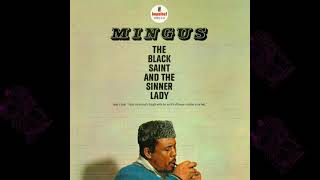
Charles Mingus (1922-1979) was an American jazz bassist, composer, big band leader, and pianist, as well as an anti-racism activist. His mother died just six months after giving birth, leaving Mingus in the care of a stepmother who only allowed church-related music in the home. In 1942, he landed some gigs with Louis Armstrong and completed his theoretical and practical training with bassist Herman Rheinshagen , debuting as a composer with Lionel Hampton 's orchestra in 1947. In 1956, he recorded his first major work: Pithecanthropus Erectus , rooted simultaneously in 20th-century classical composers and in African American blues and religious music .
In 1963, he released *The Black Saint and the Sinner Lady* , which we present here today, a multi-section masterpiece described as "one of the greatest achievements in orchestration by any composer in the history of jazz." The work is a jazz album recorded in 1963 by Charles Mingus , consisting of a six-part suite performed by an eleven-piece band. The album is structured like a ballet, drawing on influences such as Duke Ellington and Latin music . The orchestrations and the use of layering and overlapping instruments on the album make this work one of the most highly regarded in its field.

Shreya Ghoshal (born March 12, 1984, in Baharampur, India ) is one of India 's most celebrated and respected lip-syncing singers, known for her versatility, expressiveness, and technical mastery of both classical and contemporary music. Born in 1984, she began studying classical music at the age of four. Her career took off after winning the Sa Re Ga Ma Pa singing competition as a teenager. She made her professional debut in 2002 with songs for the film Devdas , which made her an instant sensation. Her repertoire encompasses romantic ballads, classical and traditionally influenced pieces, and folk and contemporary songs. She has sung in multiple languages, including Hindi, Bengali, Tamil, Marathi, Telugu, Kannada, and Malayalam , among others.
Shreya is among India 's most awarded artists, boasting five National Film Awards (one of the highest honors in Indian musical cinema), seven Filmfare Awards , and ten Filmfare South Awards for Best Female Singer. She also holds IIFA Award records for the most wins in the Best Female Playback category. She has been the most streamed Indian artist on Spotify , with millions of monthly listeners and massive YouTube views. She has performed on major international stages such as the Royal Albert Hall and the Sydney Opera House . Fans cherish her emotive timbre, impeccable classical technique, and ability to connect emotionally with each song. Her voice has become a staple in the soundtracks of many popular Bollywood and regional films.

Fermin Muguruza (1963) is a Basque singer and film director born in Irun ( Gipuzkoa ). With his brother Iñigo , he founded the band Kortatu , one of the most important groups in Basque Radical Rock . After the band disbanded, they founded Negu Gorriak , and after its demise, he continued his solo career with concerts in numerous European, American, and Asian countries, as well as collaborations with various internationally renowned artists. A staunch Basque nationalist and internationalist, he has been involved with and collaborated with various Basque and international social and political organizations and is considered one of the most influential figures in the Basque music scene.
Brigadistak Sound System : 00:00 • "Urrun" 04:37 • "Hitza Har Dezagun" 09:17 • "Newroz" 14:05 • "Puzka" 17:57 • "Harria" 20:58 • "Lagun Nazakezu" 25:09 • "Eguraldi Lainotsua Hiriburuan" 31:06 • "Maputxe" 35:36 • "Brigadistak" 39:15 • "Oasiko Erregina" 43:08 • "54-46" 47:44 • "Ari Du Hotza" 52:54 • "Nazio Ibiltaria Naiz" 58:49 • "Urrun Dub"

Shakira (1977) is a Colombian singer and songwriter who has achieved prominence in both Spanish and English. The daughter of a Lebanese father (“Shakira” is an Arabic name meaning “full of grace”) and a Colombian mother with Catalan ancestry, she won the television talent show Buscando artista infantil (Searching for a Child Artist ) at the age of eleven, a prize she would win again the following two years. At sixteen, she was invited to participate in the Viña del Mar International Song Festival , and in 2010 she was the artist who closed the FIFA World Cup in South Africa . Founder of the Pies Descalzos Foundation , dedicated to helping children who are victims of violence in Colombia , and ALAS (América Latina en Acción Solidaria - Latin America in Solidarity Action), she dedicates part of her time and money to charitable causes.
Recommended peculiar videos

Maurice Ravel (1875-1937), born in Ziburu/Ciboure (Basque Country, France), inherited his meticulous work ethic from his father, an engineer of Swiss origin, and his passion for music from his mother, born in Mendata (Bizkaia, Spain), who filled his childhood with folk songs. A few months after his birth, the family moved to Paris , where he began his piano studies at the age of six. At fourteen, he entered the Paris Conservatory , where he had the opportunity to study with Gabriel Fauré . In 1901, he premiered his Jeux d'eau , a piano work that helped him gain recognition in Parisian musical circles, where the influence of Ravel on Debussy , and vice versa, was being discussed. In 1921, he settled in a mansion near Paris , where he lived until his death. This mansion became a gathering place for eminent musicians and intellectuals. Regarding his sexuality, some of his biographers claim that Ravel was obsessed with his mother, which caused him to develop a kind of asexuality that prevented him from having intimate relationships with women or men.
Daphnis et Chloé is a ballet with music by Maurice Ravel , who described it as a "choreographic symphony ." The libretto was adapted by Michel Fokine from a novel of the same title by the Greek writer Longus (late 2nd-early 3rd century AD). It tells the story of the discovery of love by two young people, a goatherd and a shepherdess, who, after various adventures (the presence of an admirer of Chloe , Dorcon , and a prostitute who tempts Daphnis , Lyceion ; Chloe 's abduction by pirates, etc.), reach a happy ending with the marriage of the protagonists. Ravel began working on the score in 1909, commissioned by Sergei Diaghilev . The ballet premiered at the Théâtre du Châtelet in Paris, performed by the Ballets Russes, on June 8, 1912.
Today it is offered to us by Anjara Ballesteros-Cilla and Jeroen Verbruggen accompanied by Les Ballets de Monte-Carlo .
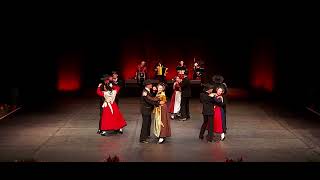
The Comberintze of Martigny-Combe is a traditional folk society from the Swiss municipality of Martigny-Combe (in the canton of Valais, Switzerland ) dedicated primarily to music, dance, and the preservation of regional cultural heritage. Founded in 1947, its mission is to study, develop, and promote the traditional dances, music, and costumes of the region, reviving the traditions of the Combe Valley by reviving dances practiced centuries ago. They rehearse and perform typical Valais folk dances and music, many of which are reconstructed from ancient costumes and customs, using traditional attire based on 19th-century clothing, as confirmed by museum research. The society, comprised of musicians, dancers of all ages, and children, participates in local and international folk festivals, representing Martigny-Combe and its culture. The group is considered a cultural ambassador for its region.
Today we witnessed one of their carefully crafted performances.
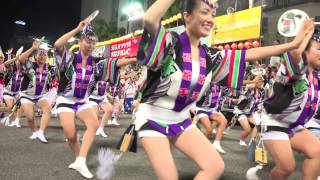
Traditional Japanese dance refers to the various artistic expressions of dance performed in Japan. It is divided into two main forms: Odori (踊り), which originated in the Edo period; and Mai (舞), which developed in western Japan . Odori developed outside the Kabuki theater stage and is more oriented towards masculine emotions; while Mai developed in private homes rather than on stage and was influenced by Noh theater. There is a variant of Mai called Kyomai , or Kyoto-style dance. It developed during the Tokugawa era in the 17th century and is strongly influenced by the sophistication and glamour of the Kyoto Imperial Court .
“Some fools dance and other fools watch. You’re a fool anyway, so why not dance?” These are the words of the famous Awa Odori . This video features the dance and a 2014 performance inspired by its Buddhist roots. (Excerpted from the video's footnote)
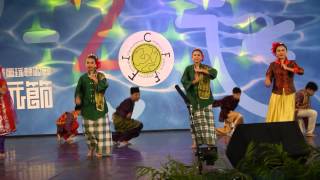
Zapin is a traditional Malay dance very popular in Singapore , as well as in other parts of Southeast Asia such as Malaysia and Indonesia . It is part of the intangible cultural heritage of the Malay community and is practiced both as a performing art and at social celebrations. Zapin is a dance with choreographed movements to the rhythm of traditional instruments such as the gambus (a short lute of Arabic origin), accordion, rebana (drum), violin, marwas, and seruling (flute). The word zapin derives from the Arabic term "zafn," which refers to quick foot movements to the beat of the music; a concept originally introduced to the Malay archipelago by traders and missionaries from Yemen/Hadramaut during the Middle Ages , combining Arabic influences with local Malay traditions . It is an energetic and lively dance with rhythmic steps, interspersed with body movements inspired by nature and daily life. Traditionally, only men practiced it; but nowadays it is common to see men and women dancing together. In Singapore , Zapin was originally performed at important family rituals such as weddings and initiation ceremonies, but over time it became a symbolic expression of local Malay culture. Zapin is not just entertainment; its movements, music, and lyrics often convey cultural and social values, such as humility, hospitality, and community, reflecting the identity of Malay culture .
Recommended music videos for children






Various Wikipedia articles have been used to write these texts.
The texts of Videomusicalis are written in Basque, Spanish and English.