

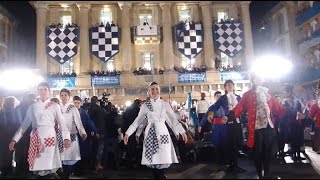
The San Sebastian Tamborrada begins on the night of January 19th to 20th.
Recommended music videos for initiation to classical music


Raimundo Sarriegi (1813-1913) was a musician from San Sebastián who composed works for choir, txistu (a Basque flute), and some zarzuelas (Spanish operettas); but above all, he was the composer of most of the music for the San Sebastián drum parade . He was born in a farmhouse (called "Etxeberri" or "Kojaenea") in the Egia neighborhood of San Sebastián/Donostia , at the end of the First Carlist War, into a family of farmers; although for many years it was believed that he was from Puyuelo Street (now Fermín Calbetón Street ) in the Old Town . From a young age, he was involved with music; he began as a treble singer in the Church of Santa María and later became a renowned tenor in the Parish of San Vicente . He was a disciple of the maestro José Juan Santesteban, known as "El Maixua," and was his favorite student.
He created and directed his own brass band, “La Cítara,” and collaborated with the San Sebastián musical movement of that time, “ La Euterpe .” He composed music for the San Sebastián Carnival , such as the Comparsa del Dios Momo (Momo the God), Comparsa de los Caldereros de la Hungría (Hungarian Coppersmiths' Comparsa), Comparsa de Iñudes y Artzaias (Wet Nurses and Shepherds' Comparsa), Caballería de Gallos (Rooster Cavalry), Caballería de Viejas (Old Women's Cavalry), and the Entierro de la Sardina (Burial of the Sardine). His best-known works are, of course, the Tatiago and Iriyarena pieces that make up the Comparsa de la Tamborrada ( Drum Parade). In 1861, before turning 23, he composed the Marcha de San Sebastián ( March of San Sebastián). He also wrote other types of musical works, such as the zarzuela “Pasayan” and “Petra Chardiñ saltzallia .” He also composed works for choir, such as “ Beti maite ” and “ Illunabarra ,” the latter with lyrics by the Tolosa poet Ramón Artola . He also wrote a " Contrapás " for the txistu (Basque flute) dedicated to his godson Eusebio Basurko , a " Minuet ," and the well-known " Alkate soñua ," which is still performed today by the Municipal Txistulari Band when they accompany the San Sebastián City Council. He was the composer of San Sebastián's popular music, music that the people listened to, sang, and danced to with joy and simplicity. There is a square and a monument in his honor in the Old Town of San Sebastián .
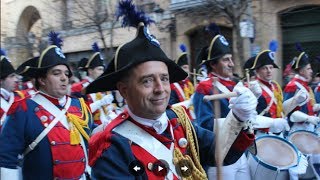
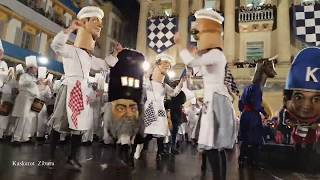
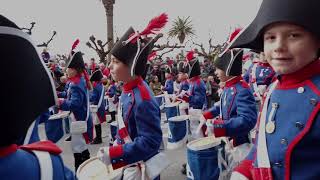
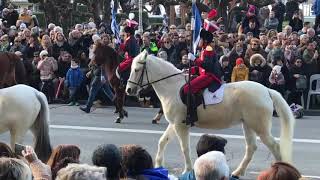
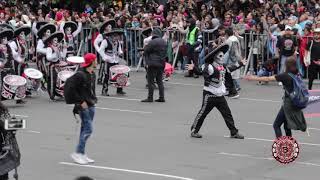
The Tamborrada of San Sebastián is the drum festival with which Donostia celebrates its patron saint , San Sebastián, starting at midnight on January 20th. In 1597, a plague epidemic struck Pasajes , then a district of San Sebastián . The residents went to the Church of San Sebastián to pray, after which the epidemic subsided. As a result, the residents adopted him as the city's patron saint, vowing to celebrate his feast day. The Tamborrada was initially a prelude to Carnival . As early as 1835, a carnival troupe, in which everyone dressed as they pleased, would parade around five in the morning on the 20th, like a reveille. It was for this troupe that Sarriegi composed his tamborrada pieces, which he would later expand upon for other Carnival troupes. In 1881, the City Council donated some drums and Napoleonic uniforms that had been kept in the San Telmo Barracks ; five years later, barrels were added, symbolizing the city's residents. The number of participating companies gradually increased, reaching 16 in 1976 and 143 in 2018. Furthermore, in 1927, the Children's Drum Parade (Tamborrada Infantil ) marched for the first time, and today it brings together more than 5,000 children. Today, the festivities begin at midnight on January 20th in the Plaza de la Constitución with the raising of the city flag and the playing of the March of San Sebastián, concluding at midnight.
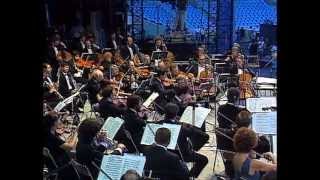
In this video we offer the March of San Sebastián by maestro Sarriegi in a version by the Orfeón Donostiarra accompanied by the Euskadi Symphony Orchestra , under the direction of Víctor Pablo Pérez .
The Austrian composer Joseph Haydn (1732-1809), whose brother Michael Haydn was also a notable composer, was one of the main pillars of the Classical period . Recognizing his musical talent, his parents sent him at the age of six to Hainburg (eleven kilometers from their home) to live with a relative and study harpsichord and violin. After two years, he was accepted as a chorister at St. Stephen's Cathedral in Vienna , where he continued his studies in singing, piano, and violin. When his voice changed, he lost his choir and his home, forcing him to take on various jobs to survive. He studied composition independently, analyzing the works of Carl Philipp Emanuel Bach , and began to make a name for himself by composing his first quartets and his first opera. He maintained a close friendship with Mozart and was also Beethoven 's teacher. He laid the main foundations of sonata form , the development of the piano trio , and, above all, the formal structure of the string quartet and the symphony . He died at the age of 77 in Vienna.
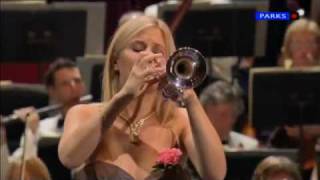
The Trumpet Concerto , The first movement of which we present today consists of three movements (fast-slow-fast), as was customary at the time; at the end of the movement, we can appreciate the cadenza (5'29") characteristic of the concerto form. The cadenza , of which there is sometimes more than one, usually comes at the end of the first movement, as in this case; in it, the soloist displays their skills freely and without accompaniment.
Our featured soloist today is Alison Balsom (1978), an English trumpeter who, despite her youth, was named Artist of the Year by the Gramophone Awards in 2013; in 2009 she performed as a soloist at the Proms in London . She has been awarded honorary doctorates from the University of Leicester and Anglia Ruskin University and is an honorary fellow of the Guildhall School of Music and Drama .
Enrique Granados Campiña (Lleida, July 27, 1867 – English Channel, March 24, 1916) was a composer, pianist, and teacher associated with the modernist movements. He is best known for his piano works, especially the Goyescas suite (1911), which also served as the basis for the opera of the same name. He founded the Barcelona School of Piano, which has produced such prominent figures as Frank Marshall, Montserrat Torrent, Narcisa Freixas, Rosa Sabater, Alicia de Larrocha, Albert Attenelle , and Douglas Riva . He is generally considered part of the modernist movements , particularly Symbolism . He died in the sinking of the Sussex in the English Channel , after being torpedoed by the German navy during the First World War . Enrique Granados's personal archive is held at the Library of Catalonia and the Barcelona Music Museum .
The Twelve Spanish Dances, Op. 37 for piano, are a series of twelve piano pieces composed by Enrique Granados . The exact dates of composition for each are unknown, although it is believed they were written between 1892 and 1900. The composer himself stated that most of them date from 1883 (when he was 16 years old). It is possible, however, that although written at an early date, they were later refined by Granados , which would reconcile two of his characteristics: on the one hand, their simplicity of notation, generally in tripartite ABA form, far removed from the complexities of his renowned work Goyescas , suggests they are early works; on the other hand, their mastery, elegance, and rhythmic control indicate that we are dealing with a mature composer. These dances constitute a significant contribution to 19th-century Spanish nationalist piano music, with the aforementioned Goyescas being his most important contribution. In an orchestral version, dances no. 2 "oriental", no. 5 "Andalusian" and no. 6 "Aragonese serenade " are performed under the name of Three Spanish Dances .
Spanish Dance No. 5, called the Andalusian or Beach Dance, is an andantino, almost an allegretto. It is the best known of all these dances and has a certain flamenco feel, hence its first name. The left hand makes a kind of fingerpicking that recalls the strumming of a guitar.
The accordion is a wind instrument consisting of a bellows, a keyboard, and two wooden sound boxes. The bellows are enclosed at both ends by the wooden boxes. The right-hand side of the accordion also has a keyboard with a layout of keys that can be either piano-style ( piano accordion ) or round keys (also called buttons ); the left-hand side has buttons on both types of accordion for playing bass notes and accompaniment chords.
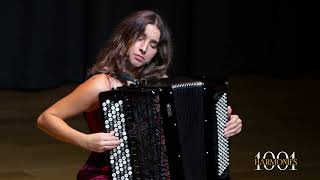
Today, in an accordion version, the Canarian accordionist Sofía Ros offers us Granados ' Spanish Dance No. 5 .

Vani Harikrishna is an Indian film lip-sync singer, songwriter, and music director, currently working in South Indian cinema, primarily for Kannada-language films. She composed, wrote, and performed several devotional songs before becoming a lip-sync singer. She won the Karnataka State Award for her performance of her song " Madhuvana Karedare ," which was featured in the film " Inthi Ninna Preethiya ." Vani made her film composition debut with the 2013 film Loosegalu .
Mussanje Veleli is a moving ballad from the film Addhuri (2012), composed by Vani Harikrishna and written by AP Arjun . This song earned Vani several awards, including the South Indian International Movie Award for Best Female Playback Singer .
Recommended classical music videos
Johann Sebastian Bach (1685-1750) Today we encounter one of the three giants of Western music, along with Mozart and Beethoven . He was a German violinist, organist, conductor, and composer, born in Eisenach into one of the most prominent musical families in history. In 1703, he obtained his first job in Arndtstadt , and in 1707 he moved to Mühlhausen as organist, where he married his cousin Maria Barbara, with whom he had seven children. After his wife's death in 1720, following a year and a half of widowhood, he remarried Maria Magdalena, with whom he had another thirteen children. In 1723, he moved to Leipzig , where he resided until his death at the age of 65. His influence has been notable on Haydn , Mozart , Beethoven , Mendelssohn , Schumann , Chopin , and many other renowned composers.
The catalogue of Bach's works, or Bach-Werke-Verzeichnis , better known by its acronym BWV , consists of a numbered index of all the composer's works, arranged thematically by genre and whether vocal or instrumental, and used by scholars and musicians worldwide. This catalogue was created in 1950 by the German musicologist Wolfgang Schmieder .
The St. Matthew Passion is an oratorio written by Bach for solo voices, double choir, and double orchestra. It depicts the suffering and death of Christ according to the Gospel of St. Matthew and is the composer's longest work. The work is divided into two main parts, between which the sermon takes place, corresponding to chapter 26 and chapter 27 of the Gospel of St. Matthew , respectively. The text is sung verbatim by one of the Evangelists , while the other characters ( Christ, Judas, Peter , etc.) are portrayed by different soloists. The biblical text is set to relatively simple music in recitatives , while the long, contemplative ariosos and arias present new poetic texts that comment on the various events of the biblical narrative and lend a more intimate character to the life of Christ . The St. Matthew Passion was performed on April 15, 1729 (Good Friday) at St. Thomas Church in Leipzig under the composer's direction, in a performance for which Bach lacked the necessary resources (in a memorandum to the Leipzig City Council , he complained that only 17 of the 54 choir members had been up to standard). After Bach 's death, the work fell into obscurity (as, generally, did all of the composer's output), and it was not until 1829 that Mendelssohn revived it with the Berlin Sing-Akademie in an abridged version. This revival sparked a strong interest in the study and analysis of Bach 's works, particularly his large-scale pieces, an interest that continues to this day.
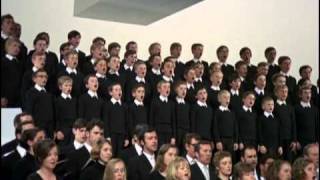
The opening chorus of Johann Sebastian Bach 's St. Matthew Passion ("Kommt, ihr Töchter, helft mir klagen") is one of the most moving and masterful works in the Baroque sacred repertoire. From the very beginning, a tone of profound lament, contemplation, and reverence is established. Bach not only seeks to narrate the Passion of Christ , but to make it an emotional experience for the listener, and to this end he uses two choirs and two orchestras, which engage in a dialogue with each other, creating a dramatic, almost theatrical effect.
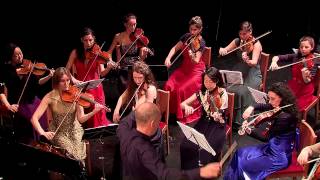
Leopold Kozeluch (1747–1818) was a Czech composer. After completing his musical training in Prague with František Xaver Dušek (1731–1799), he arrived in Vienna in 1778, where he taught piano to students such as Josef M. Wolfram, Ignaz von Seyfried, Maria Theresia von Paradis, Elisabeth Wilhelmina of Württemberg (first wife of Emperor Francis I of Austria), and Marie Louise of Austria (daughter of the Emperor and second wife of Napoleon I). In 1790, his works were performed in London alongside those of Joseph Haydn . In 1792, after Mozart 's death, he succeeded him as Assistant Kapellmeister and composer to the Imperial Court of Austria, a position he held until 1813, when he was replaced by Franz Krommer . Among his compositions are an oratorio (Moses in Egypt), 6 operas, 11 symphonies, 22 piano concertos and some piano sonatas.
Kozeluch 's Piano Concerto for Four Hands is structured in three movements, as is usual in the Classical period : I (0'30'') ALLEGRO .-. II (10'50'') ADAGIO .-. III (17'29'') RONDO: ALLEGRETTO.
The performance we present today is by pianists Roberto Arosio and Alessandra Gelfini , accompanied by the Camerata dei Castelli , conducted by British maestro Andreas Laake.
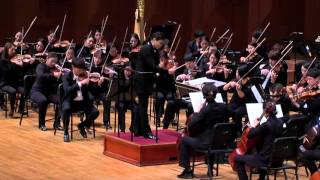
Pyotr Tchaikovsky (1840-1893) was a Russian composer who graduated from the Saint Petersburg Conservatory and wrote works in various genres, though he achieved his greatest success with his ballets. In 1859, he obtained a civil service position in the Ministry of Justice , which he left after three years to dedicate himself solely to music. His personal life was plagued by continuous crises, beginning with the death of his mother and compounded by his repressed homosexuality, which led him into a marriage that lasted only a few months. He wrote more than 150 compositions, including piano works, quartets, suites, symphonies, concertos, choral pieces, cantatas, operas, and ballets. He died at the age of 53 and is considered one of the greatest composers in history.
Symphony . The word symphony derives from the Latin symphonĭa, which in turn comes from the Greek συμφωνία (symphōnía), meaning “consonance,” as opposed to διαφωνία (diaphōnia), meaning “dissonance.” In the Middle Ages and later, the word symphony was used to describe various instruments, especially those capable of producing more than one sound simultaneously, in the sense of “sounding together.” The word began to appear in the titles of some works by composers of the 16th and 17th centuries, and by the end of the 18th century, the word had already acquired its current common meaning: a work that generally consists of four distinct sections or movements and is most often composed for orchestra.
Pyotr Ilyich Tchaikovsky 's Symphony No. 4 in F minor, Op. 36, was composed between 1877 and 1878. During the composition of the symphony, Tchaikovsky wrote to his patron, Nadezhda von Meck , that he "very much" wished to dedicate it to her, and that he would inscribe in the score "Dedicated to my best friend." He had begun composing the symphony shortly after Meck entered his life. He would complete it after their disastrous marriage, and stated that she would find in it "an echo of your most intimate thoughts and emotions." The premiere took place at a concert of the Russian Musical Society in St. Petersburg on February 10 (Julian calendar) or February 22 (Gregorian calendar) 1878, conducted by Nikolai Rubinstein .
The symphony is structured in four movements: I (0'21') ANDANTE SOSTENUTO-MODERATO CON ANIMA-MODERATO ASSAI, QUASI ANDANTE-ALLEGRO VIVO.-. II (18´38´´) ANDANTINO IN MODO DI CANZONA.-. III (29´08´´) SCHERZO: PIZZICATO OSTINATO-ALLEGRO.-. IV (34´25´´) FINALE: ALLEGRO CON FUOCO.
Today it is offered to us by the Gyeonggi Philharmonic Orchestra under the baton of the Korean maestro Shiyeon Sung.
Darius Milhaud (1892–1974) was a French composer known for his use of polytonality and rhythmic patterns derived from jazz. In 1916, he traveled to Brazil as secretary to Paul Claudel , then ambassador; there he wrote Saudades do Brasil , Scaramouche , Le Bœuf sur le toit , and the choreographic poem L'Homme et son desir . In 1918, he returned to France , befriended Erik Satie , and joined the group Les Six . In 1940, he fled the Nazi occupation of France and moved to the USA , where he remained until 1947, working as an honorary professor of composition at the Paris Conservatory . He wrote more than 400 works in all kinds of musical genres, from chamber music to choral works, symphonies, operas, and incidental music.
Les Six was a French group of musicians from the early 20th century, composed of Georges Auric, Louis Durey, Arthur Honegger, Darius Milhaud, Francis Poulenc, Germaine Tailleferre (the only woman in the group), Jean Cocteau (the only one who wasn't a musician, but rather their artistic manager), and Erik Satie (who left the group in 1918). The group, which Erik Satie christened "Les Nouveaux Jeunes" ("The New Young Ones"), first met in the studio of the painter Lejeune in Montparnasse . Their program was summarized in a single objective, also formulated by Satie : "These societies, the National, the SMI, play other people's music; we will create a society to play our own music." Their music was fundamentally a rebellion against Impressionism and Wagnerism ; and although they wrote some works collectively, each member developed their own distinct and personal style. After numerous disagreements, they never saw each other again after 1930, refusing to give explanations.
Concerto for Percussion and Small Orchestra is one of the earliest concertos written for a solo percussionist and is one of the most frequently performed pieces in the repertoire. It was written in Paris for percussion and a small orchestra. Composed in the 1920s, this piece emerged at the height of the jazz era ; however, Milhaud intended to avoid incorporating jazz ideologies into his music. In this work, he countered the jazz style by composing it in a polytonal form. The percussion ideas used in this piece are not composed with a solo focus; rather, the entire percussion section is played by a single person.
The work consists of two movements: I VIF, RUDE ET DRAMATIQUE (0'21") A harsh and dramatic movement based on polytonal harmonies. II MODÉRÉ (3'09") A lyrical movement, contrasting with the previous one and featuring short solos from various instruments, interrupted in the final section by brief reminiscences of the initial theme. Today's soloist is the master percussionist Laura Trompetter . (Excerpts from the article by Elizabeth Kosko, 2010)
Drums of Donostia
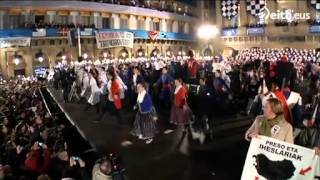
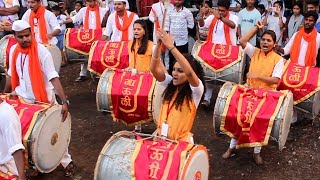
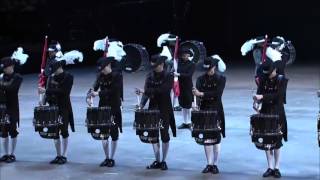
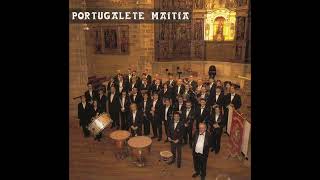
The drum is a percussion instrument of indefinite pitch, belonging to the membranophone family (the instrument's vibration is produced by a membrane made of skin or synthetic materials). It consists of a resonating chamber, usually cylindrical, and a membrane called a drumhead, which covers the opening of the chamber. Some types of drums have heads on both sides, and the sound is usually produced by striking the drumhead with the hand or drumsticks. On the other hand, and especially in colloquial language, the word "drum" is also applied to other percussion instruments that are not membranophones but idiophones (the sound is produced by the vibration of the instrument itself); in the case of the Tamborrada San Sebastián , the wooden barrels of the replicants. It follows, therefore, that for an instrument to be considered a drum, the act of percussion is more decisive than the presence of vibrating membranes.
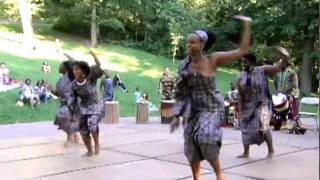
Drums of the world
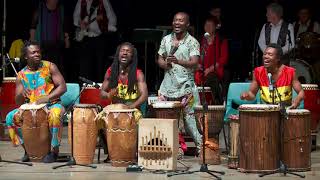
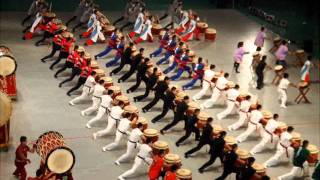
A percussion instrument is a type of musical instrument that produces sound when struck, shaken, or scraped with a stick, mallet, or beater, including attached or closed beaters or rattles struck, scraped, or rubbed by hand or struck against another similar instrument. The percussion section of an orchestra typically includes instruments such as timpani, bass drum, cymbals, triangle, and tambourine. However, the section may also include non-percussion instruments, such as a whistle and siren, or a blown conch shell. Percussion techniques can even be applied to the human body itself, as in body percussion. Percussion is distinguished by the variety of timbres it can produce and its ease of integration with other musical instruments. It is worth noting that a wide range of sounds can be obtained depending on the different sticks or mallets used to strike some percussion instruments. A percussion instrument can be used to create rhythm patterns (drums, tam-tam or vallenato box, among others) or to emit musical notes (xylophone).
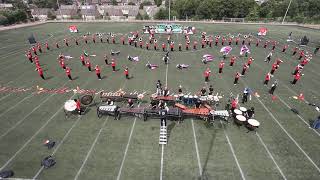
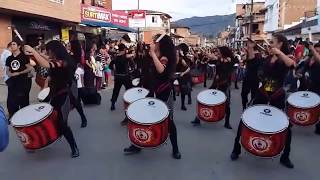
A percussion group is a musical ensemble composed primarily of percussion instruments, which can be either tuned percussion (such as marimba, vibraphone, or timpani) or untuned (such as drums, cymbals, bongos, cajón, etc.) and may include traditional instruments (drums, congas, timbales, or folk instruments) as well as non-traditional ones (everyday objects or electronic instruments). The central focus of these groups is the creation of rhythms, textures, and timbres, or the accompaniment of other instrumental groups.
Recommended music videos for children





Various Wikipedia articles and relevant information on Artificial Intelligence were used to prepare these texts.
The texts of Videomusicalis are written in Basque, Spanish and English.