

March 29th is Palm Sunday, which marks the beginning of Holy Week.
Johann Sebastian Bach was born on March 31, 1685
Joseph Haydn was born on March 31, 1732
Recommended music videos for initiation to classical music


Tomás Luis de Victoria (1548–1611) was a Catholic priest and celebrated polyphonic composer of the Spanish Renaissance, born in Ávila . At the age of seven, he entered the choir of Ávila Cathedral, where he felt his calling to the priesthood and received his first musical training. At the age of 19, he moved to Rome , where he furthered his studies with the renowned composer Palestrina . In May 1585, Victoria returned to Spain as chaplain to Empress Maria of Austria and organist of the Monastery of Las Descalzas Reales , where he worked for 24 years until his death. Victoria is considered one of the most important and progressive composers of his time, with an innovative style that foreshadowed the imminent Baroque period.
" Pueri Hebraeorum " by Tomás Luis de Victoria is a processional antiphon that forms part of the liturgical repertoire for Holy Week , specifically for Palm Sunday . This piece is one of the many religious compositions by this master of the Spanish Renaissance , considered one of the most important composers of sacred music of the 16th century . The text " Pueri Hebraeorum " translates as " The Hebrew children " ("The Hebrew children, carrying olive branches, went out to meet the Lord, shouting and saying: Hosanna in the highest!") and refers to the triumphal entry of Jesus Christ into Jerusalem , when he was received by a multitude who acclaimed him with palms and olive branches. It is traditionally sung during the Palm Sunday procession, which commemorates this event. The antiphon is written for four voices (SATB) a cappella in modal style , as is typical of Renaissance polyphony, with a clear influence of the Palestrina style but with an emotional and expressive character that is characteristic of Victoria .
Johann Sebastian Bach (1685-1750) Today we encounter one of the three giants of Western music, along with Mozart and Beethoven . He was a German violinist, organist, conductor, and composer, born in Eisenach into one of the most prominent musical families in history. In 1703, he obtained his first job in Arndtstadt , and in 1707 he moved to Mühlhausen as organist, where he married his cousin Maria Barbara, with whom he had seven children. After his wife's death in 1720, following a year and a half of widowhood, he remarried Maria Magdalena, with whom he had another thirteen children. In 1723, he moved to Leipzig , where he resided until his death at the age of 65. His influence has been notable on Haydn , Mozart , Beethoven , Mendelssohn , Schumann , Chopin , and many other renowned composers.
The catalogue of Bach's works , or Bach-Werke-Verzeichnis , better known by its acronym BWV , consists of a numbered index of all the composer's works, arranged thematically by genre and whether vocal or instrumental, and used by scholars and musicians worldwide. This catalogue was created in 1950 by the German musicologist Wolfgang Schmieder .
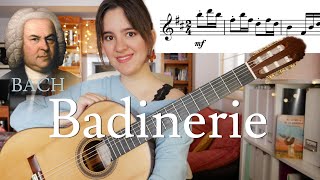
Badinerie is a French word meaning something like "joke" or "lightness," and in music it refers to a short, light, and lively piece, usually part of a Baroque suite. In the musical context, it is best known thanks to the work of Johann Sebastian Bach , who composed this famous Badinerie as part of the second and final movement of his Orchestral Suite No. 2 in B minor, BWV 1067. This piece was written for flute and strings and is especially famous for its virtuosity, joy, and speed.
Today, guitarist Paola Hermosín offers us her own guitar arrangement of this work with a very didactic verbal introduction.
Franz Joseph Haydn (1732-1809), an Austrian composer whose brother Michael was also a notable composer, was one of the principal figures of the Classical period (1750-1810). At the age of six, he began his studies of harpsichord and violin. At eight, he was admitted as a chorister to St. Stephen's Cathedral in Vienna , where he received lessons in singing, piano, and violin. After his voice changed, he had to support himself by working various jobs while studying composition, analyzing the works of Carl Philipp Emanuel Bach . He laid the foundations for sonata form and the formal structure of the string quartet and the symphony ; he maintained a close friendship with Mozart and was Beethoven 's teacher. He died at the age of 77 in Vienna .
The Creation (Die Schöpfung ) is an oratorio composed by Joseph Haydn between 1796 and 1798 and premiered on April 29, 1798, in Vienna . The work illustrates the creation of the world, as narrated in Genesis . In addition to this book of the Old Testament , its sources of inspiration include the Psalms and John Milton 's Paradise Lost ; Baron Gottfried Van Swieten was responsible for preparing the text. Its premiere took place in Vienna on April 19 and 30, 1798, achieving resounding success, even greater than its performances in England . A year later, it premiered in Paris, London, Berlin, and Prague , always with equal success. From then on, as long as his age and health permitted, Haydn conducted an annual performance of the work in Vienna , generally for charitable purposes. The Creation is one of his masterpieces and one of the greatest choral compositions of the 18th century .
The aria "Nun beut die Flur das frische Grün" ( Now the field offers its fresh green ) is one of the best-known arias from Joseph Haydn 's oratorio The Creation . This aria appears on the fourth day of Creation , when God has caused plants, flowers, and trees to grow on the Earth. The lyrics of this aria celebrate the beauty of newly created Nature, with a pastoral and contemplative tone. It is a hymn to the rebirth of plant life, alluding to green fields, leafy forests, and the vibrant colors that fill the Earth. In this scene, the archangel Raphael sings about the creation of vegetation. It is a profoundly serene, lyrical, and expressive piece of music that conveys a sense of peace, order, and harmony in the natural world.
Edward Elgar (1857-1934) was an English composer born near Worcester . At the age of eight, he began his violin and piano studies. At 22, he was appointed director of the band at Powick Asylum ; he played in the Worcester and Birmingham Festival orchestras, performing Dvořák 's Symphony No. 6 and Stabat Mater, conducted by the composer himself. Finding it difficult to gain recognition in London , he returned to Worcester to conduct local bands and teach music. At 42, he wrote the Enigma Variations , which catapulted him to the forefront of British music as the most important composer of his time. In 1904, he was knighted at Buckingham Palace ; from then on, he received numerous prestigious awards and accolades.
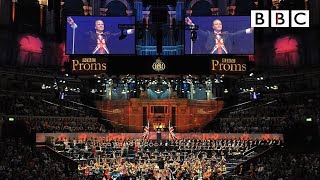
Pomp and Circumstance No. 1 is the first and best-known of a series of five marches composed by Elgar ; it consists of two distinct parts (fast-slow) presented in a repetitive pattern (ABAB); in this case, the slow part was used to incorporate patriotic lyrics, "Land of Hope and Glory," which were first sung at the coronation of Edward VII and are now often performed at the BBC Proms , as in the video we suggest today, directed by Sakari Oramo, one of Finland's most eminent directors.
Recommended classical music videos
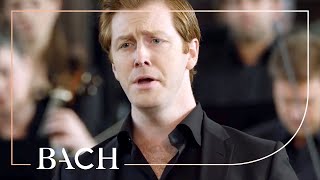
Johann Sebastian Bach (1685-1750) was a German violinist, organist, conductor, and composer. He was born in Eisenach into one of history's most prominent musical families, which boasted over 30 famous composers. In 1703, he obtained his first position as a court musician for the Prince of Arndtstadt , and in 1707, he moved to Mühlhausen as organist, where he married his cousin Maria Barbara, with whom he had seven children. After his wife's death in 1720, he remarried a year and a half later to Maria Magdalena, with whom he had thirteen more children. In 1723, he moved to Leipzig , where he resided until his death at the age of 65. A prolific composer, he is considered one of the three greatest geniuses in the history of music, along with Mozart and Beethoven.
The catalogue of Bach's works, or Bach-Werke-Verzeichnis , better known by its acronym BWV , consists of a numbered index of all the composer's works, arranged thematically by genre and whether vocal or instrumental, and used by scholars and musicians worldwide. This catalogue was created in 1950 by the German musicologist Wolfgang Schmieder .
The St. Matthew Passion is an oratorio written for solo voices, double choir, and double orchestra by Bach . It presents the suffering and death of Christ according to the Gospel of St. Matthew and is the composer's longest work. The work is divided into two main parts, between which the sermon takes place. The first part (0:06) corresponds to chapter 26, from the conspiracy against Jesus to Peter 's denial, and the second part (1:32:34) to chapter 27 of the Gospel of St. Matthew, from Jesus ' trial to his crucifixion and burial. The text is sung verbatim by one of the Evangelists , while the other characters in the story ( Christ, Judas, Peter , etc.) are portrayed by different soloists. On the other hand, the biblical text is set to music in a relatively simple manner in recitatives , while the ariosos and arias , long and contemplative, present new poetic texts that comment on the various events of the biblical narrative and lend a more intimate character to the life of Christ . The St. Matthew Passion was performed on April 15, 1729 (Good Friday) in St. Thomas Church in Leipzig under the composer's direction, in a performance for which Bach did not have the necessary resources (in a memorandum to the Leipzig City Council , he complained that only 17 of the 54 choir members had been up to par). After Bach 's death, the work fell into oblivion (as, in general, did all of the composer's work) and it was not until 1829 that Mendelssohn revived it with the Berlin Sing-Akademie in an abridged version. The reinterpretation of this work sparked a strong interest in the study and analysis of Bach 's works, particularly the large-scale ones, which has persisted to this day.
The version we present today is offered to us by the Dutch Bach Society led by the Dutch maestro Josephus van Veldhoven (1952).

Franz Joseph Haydn (1732-1809), an Austrian composer whose brother Michael was also a notable composer, was one of the principal figures of the Classical period (1750-1810). At the age of six, he began his studies of harpsichord and violin. At eight, he was admitted as a chorister to St. Stephen's Cathedral in Vienna , where he received lessons in singing, piano, and violin. After his voice changed, he had to support himself by working various jobs while studying composition, analyzing the works of Carl Philipp Emanuel Bach . He laid the foundations for sonata form and the formal structure of the string quartet and the symphony ; he maintained a close friendship with Mozart and was Beethoven 's teacher. He died at the age of 77 in Vienna .
The catalogue of Haydn's works . Joseph Haydn's works are classified today according to the system created by Anthony van Hoboken. Each work is identified by a Roman numeral that corresponds to the category, which in most cases is associated with a genre. Some categories have subdivisions, indicated by a lowercase letter followed by an Arabic numeral that corresponds to the work's position within the category. These numerals are preceded by the word Hoboken (in memory of the catalogue's author) and sometimes by Hob (its abbreviation).
Sturm und Drang (storm and stress) is a term that originates not in music but in literature; it is understood as a reaction against the Baroque . In music, it criticizes polyphonic structure and mathematical speculation or symbolism, formulas that do not allow for adequate and simple expression, and the objective, rational, and comprehensible method. Emotional intensity, subjectivity in expression, and rebellion against social and artistic conventions are transferred to music. By creating heightened tension and incorporating a passionate gravity, the aim is to achieve a new dramatic sense, distinct from classicism .
The Symphony No. 45 in F-sharp minor, Hob. I:45, also known as the Abschiedssinfonie , Farewell Symphony, or Farewell Symphony, was composed by Joseph Haydn in 1772, during the composer's Sturm und Drang period. The Symphony is divided into four movements: I (0'05') ALLEGRO ASSAI. The first movement is written in the key of F-sharp minor , in 3/4 time, and follows sonata form (exposition-development-recapitulation). It is a turbulent and agitated episode in a key extremely unusual for the 18th century, which lends it a sense of tension. It begins in the typical manner of Haydn's Sturm und Drang period, with descending minor arpeggios in the first violins along with syncopated notes in the second violins and sustained chords in the winds. The composer experiments with form, following sonata form, although deviating from the model on several occasions. II (5'18") ADAGIO. The second movement, in A major , in 3/8 time, also adheres to sonata form . The movement begins with a relaxing melody played by muted violins; the atmosphere gradually becomes more somber and contemplative with the alternation between major and minor modes. This is followed by a series of dissonant suspensions held for several bars, which are extended to a considerable duration, while the same material appears in the recapitulation. III (12'50") MENUET. ALLEGRETTO – TRIO. The third movement is in F-sharp major and the time signature is 3/4. In the Minuet, it is noteworthy that the final cadence of each section is constructed in such a way that it sounds very weak (the accent falling on the third beat of the measure) and creates a sense of incompleteness. - IV (17'00") FINALE. PRESTO – ADAGIO. The fourth and final movement returns to the initial key of F-sharp major , and the time signature is alla breve in the Presto and changes to 3/8 in the Adagio . It begins, as is characteristic of Haydn, as a rapid finale in sonata form and in the tonic of the work. The Adagio of this movement is written in 3/8 time and modulates from A major to F-sharp minor , at which point the musicians leave their seats in the following order: first oboe and second horn (with solos), bassoon (without solo), second oboe and first horn (with solos), double basses (solo), cellos (without solo), orchestral violins (with solos; first-chair players do not play), viola (without solo). The first-chair violins remain to complete the work.
Today we have the opportunity to hear it from the Affrettando Chamber Orchestra, conducted by the Russian maestro Anna Rakitina.
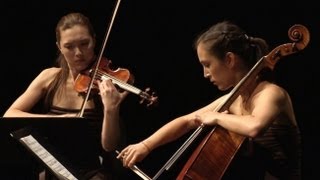
Maurice Ravel (1875-1937), born in Ziburu/Ciboure (Basque Country, France), inherited his meticulous work ethic from his father, an engineer of Swiss origin, and his passion for music from his mother, born in Mendata (Bizkaia, Spain), who filled his childhood with folk songs. A few months after his birth, the family moved to Paris , where he began his piano studies at the age of six. At fourteen, he entered the Paris Conservatory , where he had the opportunity to study with Gabriel Fauré . In 1901, he premiered his Jeux d'eau , a piano work that helped him gain recognition in Parisian musical circles, where the influence of Ravel on Debussy , and vice versa, was being discussed. In 1921, he settled in a mansion near Paris , where he lived until his death. This mansion became a gathering place for eminent musicians and intellectuals. Regarding his sexuality, some of his biographers claim that Ravel was obsessed with his mother, which caused him to develop a kind of asexuality that prevented him from having intimate relationships with women or men.
Maurice Ravel 's Trio for Piano, Violin, and Cello is a chamber work composed in 1914 and dedicated to his counterpoint teacher, André Gedalge . Ravel had been planning to compose a trio for at least six years before beginning serious work on it in March 1914. Initially, Ravel remarked to his student Maurice Gedalge , "I have composed my trio. Now I only need the themes." During the summer of 1914, Ravel carried out his compositional work in the French Basque commune of Saint-Jean-de-Luz . Ravel was born across the bay in the Basque town of Ciboure ; his mother was Basque, and he felt a deep connection to his Basque heritage. While composing the Trio , Ravel was also working on a piano concerto based on Basque themes entitled Zazpiak Bat (Basque for "The Seven Are One"). Although ultimately abandoned, this project left its mark on the Trio , particularly on the opening movement, which Ravel would later describe as having a "Basque flavor." Inspiration for the Trio 's musical content came from a wide variety of sources, from Basque dance to Malay poetry . However, Ravel did not deviate from his usual predilection for traditional musical forms. The Trio follows the standard format of a four-movement classical work, with the outer sonata-form movements flanked by a scherzo, a trio, and a slow movement. Nevertheless, Ravel manages to introduce his own innovations within this conventional framework.
Structure. I (0'13') MODÉRÉ (A minor - C major). According to Ravel , the first movement is inspired by the zortziko , a Basque rhythmic form. The movement is written in 8/8 time, where each measure is subdivided into a 3+2+3 rhythmic pattern. The influence of Zazpiak Bat is most evident in the opening theme, whose rhythm is identical to that of the main theme of Zazpiak Bat , but with note values halved. Ravel employs sonata form in this movement, but with his own distinctive touches. The second theme is presented in the tonic of A minor and reappears without transposition in the recapitulation, but with different harmonies. To avoid overuse of the tonic key, Ravel ends the movement in the relative major of C major . In the recapitulation, the appearance of the main theme in the piano is superimposed on a rhythmically modified version of the second theme in the strings. II (9'21") PANTOUM: ASSEZ VIF (A minor - F♯ major - F♯ minor - F major - A major). This movement is based on a traditional scherzo and an ABA trio form. The scherzo presents two themes: the piano opens with the first theme, with a sharp touch, in A minor , while the strings respond in double octaves with the second, gentler theme in F♯ minor . The movement's name refers to a Malay versical form , in which the second and fourth lines of each four-line stanza become the first and third of the next. III (14'25") PASACALLE: MUY GRANDE (F♯ minor). The third movement is a passacaglia based on the opening eight-bar piano bass line, derived from the first theme of the Pantoum . The cello then enters, followed by the violin. As the melody alternates between the three instruments, the movement unfolds as a single piece to a powerful climax, before fading away. IV (21'38") FINAL: LIVELY (A major). Against a background of violin arpeggio harmonics (previously used by Ravel in his Three Poems by Mallarmé ) and double-register cello trills, the piano presents the first five-bar theme. As in the first movement, irregular time signatures are again used: the movement alternates between 5/4 and 7/4. The trumpet calls in the development section (played by the piano) could be an allusion to the declaration of war in August 1914, which coincided with Ravel 's work on this movement. Being the most orchestral of the four movements, the Finale makes the most of the resources of the three performers, and Ravel rounds off the work with a brilliant Coda .
Today's version is brought to us by the Gaspard Trio : Hyo-Sun Lim (piano), Jonian Ilia Kadesha (violin), Vashti Mimosa Hunter (cello)
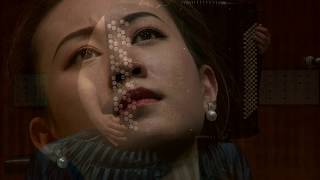
Sofia Gubaidulina (1931) is a Russian composer born in Tatarstan . She studied piano and composition at the Kazan Conservatory ; in 1954 she moved to Moscow where she continued her studies, graduating in 1963. Her music was criticized for its exploration of alternative tunings, although Shostakovich encouraged her to continue forging her own path. Her violin concerto, Ofertorium, performed by Gidon Kremer, brought her critical acclaim. In 2002, she received the Polar Music Prize , awarded by the Royal Swedish Academy of Music .
The composition we present today, De Profundis , is a demonstration of all the remarkable things the accordion can do in the hands of a virtuoso. Sofia Gubaidulina went to great lengths to study the accordion with the Russian player Friedrich Lips and fully exploits its resources. De Profundis is a work of complex polyphony, dense groups of notes, glissandi, quasi-percussive effects, and sounds of sepulchral breathing (the instrument has what is called an 'air button'); all within a very wide dynamic range and contrasting tempos.
Hanzhi Wang (born 1990 in Suzhou , Jiangsu Province, China ) is the first accordionist to earn a place on the Young Concert Artists list in its 58-year history and the first time a solo accordionist has appeared on WQXR's Young Artists Showcase program in New York . She also won First Prize at the 40th Castelfidardo International Accordion Competition in Italy. Her active career includes recitals, lectures, performances, and masterclasses at the Manhattan School of Music, the Royal Danish Academy of Music, the Tianjin Conservatory of Music, the Ghent Conservatory of Music, and in Norway and Portugal . Composers Martin Lohse, James Black , and Sophia Gubaidulina have written and dedicated works to her. Hanzhi Wang earned her bachelor's degree from the Central Conservatory of Music in Beijing , China , and completed her master's degree at the Royal Danish Academy of Music in Copenhagen .
Recommended music videos for all tastes
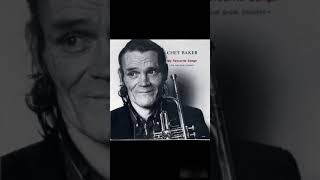
Chet Baker (1929-1988) was an American jazz trumpeter, singer, and musician. An exponent of the cool jazz style (the West Coast jazz of the 1950s), Baker was popularly nicknamed the James Dean of jazz due to his good looks. This, along with the intimacy and lyrical elegance of his early performances—as well as his distinctive voice for the genre—led to his recognition by both the public and critics when he debuted as a soloist, although he had already made notable appearances with jazz groups such as Charlie Parker & Chet Baker and the Gerry Mulligan Quartet .

Asha Bhosle is an Indian singer best known for providing the voice for many lip-sync performances in Bollywood films, though her repertoire is much broader. Her career began in 1943 and spanned six decades, during which she appeared in over 950 Bollywood films and released numerous albums. Asha Bhosle is one of the most versatile voices in South Asia : her repertoire encompasses film soundtracks, pop, ghazal, bhajan, traditional Indian classical music, folk, qawwali , and rabindra sangeet . She has sung in more than 14 languages, including Hindi, Marathi, Bengali, Gujarati, Punjabi, Tamil, English, Russian, Nepali , and Malay . It is believed she has sung over 12,000 songs, but these estimates are difficult to verify.
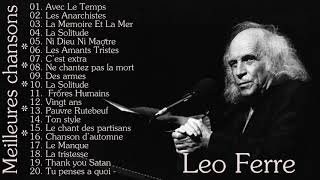
Léo Ferré (Monaco, 1916–1993) was a French-born Monegasque singer-songwriter, pianist, and poet. Having composed more than forty original albums over a period of 46 years, he is the most prolific singer-songwriter in the French language. He defined himself as an anarchist, a way of thinking that greatly inspired his work. Along with the Belgian Jacques Brel (1929–1978) and Georges Brassens (1921–1981), he is considered one of the great composers of the chanson . At the age of five, he joined the Monaco Cathedral choir as a treble, where he discovered polyphony through the works of Palestrina and Tomás Luis de Victoria . His uncle, Albert Scotto , the Casino 's theater director, took him to performances and rehearsals where he heard the voice of Fyodor Chaliapin and witnessed Arturo Toscanini conducting, through whom he discovered Beethoven . But what impressed him most was Maurice Ravel 's presence at the rehearsals of L'enfant et les sortilèges . In 1940, for his sister's wedding, he wrote an Ave Maria for organ and cello and began composing music for songs with lyrics written by a friend. After a difficult period, both emotionally and financially, he eventually built a solid reputation, and his songs reached the voices of some of the leading artists of the time: Édith Piaf, Henri Salvador, Yvette Giraud, and Les Frères Jacques . But it was in the singer Catherine Sauvage that he found the most loyal, passionate, and persuasive ambassador for his work.

Manuela Taubert (September 11, 2000), known as Ela Taubert , is a Colombian Latin pop singer and songwriter. In 2024, she won the Best New Artist award at the Latin Grammy Awards . Born and raised in Bogotá , she showed an early interest in music, which her mother encouraged by enrolling her in classes and motivating her to sing at public events, despite her shyness. In 2022, Taubert released her first single, " Los rotos "; however, her big break came with " Crecer ," which allowed her to establish herself in the industry. In 2023, she released her first EP, "¿Quién dijo que era fácil?" (Who Said It Was Easy? ), composed of five songs inspired by universal themes based on the artist's own experiences, such as falling in love, self-love, and personal journeys. In 2024, she opened for Karol G on her Bogotá tour. She also won the Premios Juventud award for " The new female generation ", and a Latin Grammy award for Best New Artist .
Recommended peculiar videos
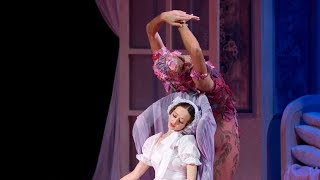
Carl Maria von Weber (1786-1826) was a German composer. From a very young age, he learned to sing and play the piano, and at the age of 12, he received free lessons in Salzburg from Michael Haydn , brother of Joseph Haydn . In 1812, his father died, and the following year he was appointed director of the Prague orchestra and later of the Dresden orchestra, while working on his most famous opera, Der Freischütz (The Free-Raising Der). He also composed two other operas, Euryanthe and Oberon ; all three are considered by many critics to be masterpieces of the stage opera genre. In addition to other operas, he composed numerous songs, piano works, chamber works, two symphonies, several overtures, concertos and concertante works for various instruments, three masses, and eight cantatas.
Michel Fokine (1880-1942) was a Russian-born American dancer, choreographer, ballet master, and company director. He studied dance at the Imperial School and was a dancer with the Imperial Ballet of the Mariinsky Theatre in St. Petersburg . His comprehensive concept of dance and his innovations in choreography, which revolutionized classical Russian ballet, had an international impact.
The Spectre of the Rose , which we recommend today, is a ballet created by Michel Fokine for a mixed-gender pair of dancers, set to music for piano by Carl Maria von Weber . Invitation to the Dance is the title of the piano work written by Weber , which was later orchestrated by Hector Berlioz . Today, it is presented by the Ballets Russes .
Don Quixote is a ballet with a prologue and four acts by Ludwig Minkus and choreography and libretto by Marius Petipa , which would be premiered in 1869 at the Bolshoi Theatre , with enormous success from both critics and the public; a ballet whose plot is based on the novel by Miguel de Cervantes and in particular on the "wedding of Camacho" ( Gamache in the ballet), an episode narrated in chapter XIX of the second part, in which the romance between the barber Basilio and the young Quiteria (Kitri in the ballet) is recounted.
Today we offer some excerpts in interpretation by the Russian ballerina Maya Plisetskaya (1925-2015), one of the greatest ballet dancers of the Bolshoi Theatre and one of the undisputed symbols of classical dance, who was given the title of prima ballerina assoluta .
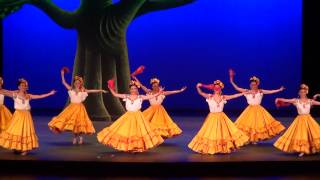
Amalia Hernández (1917-2000) was a Mexican dancer and choreographer who, in 1952, founded the ballet company that bears her name. This company, an emblem of Mexican folk art, is based at the Palace of Fine Arts in Mexico City. Amalia dedicated herself to rescuing traditional Mexican dances that had been lost over time, striving to improve their quality. In 1959, President López Mateos asked the group to become one of Mexico 's natural ambassadors. The Ballet Amalia Hernández , also known since then as the Ballet Folklórico de México , boasts more than 60 original choreographies, performing throughout Mexico and undertaking more than 100 international tours, visiting a total of 60 countries.
The Dance of the Yellows comes from the patron saint festivals of the State of Guerrero , Mexico , where Amalia Hernández rescued and popularized it as we present it today.
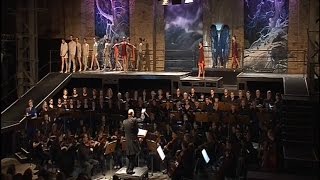
Christ on the Mount of Olives, Op. 85, is an oratorio by Ludwig van Beethoven that portrays the emotional turmoil of Jesus on the Mount of Gethsemane before his crucifixion. Written in a very short period, the work is a dramatic oratorio and is considered a far more humanistic depiction of Christ 's Passion than other settings, such as those by Bach . It concludes at the point where Jesus personally accepts his fate, emphasizing his own decision rather than the subsequent Crucifixion or Resurrection . The oratorio is scored for soprano, tenor, and bass, with a standard SATB choir and symphony orchestra. The tenor sings as Jesus , the soprano as a Seraph (angel), and the bass as Peter .
Today we present it with Valentina Farcas as soprano, Jörg Dürmüller as tenor, Dietrich Henschel as bass, the Munich Bach Choir and the Munich Bach Orchestra , all conducted by Maestro Hansjörg Albrecht in a ballet version choreographed by Marguerite Donlon and with the Donlon Dance Company on stage.
Recommended music videos for children






Various Wikipedia articles and relevant information on Artificial Intelligence were used to prepare these texts.
The texts of Videomusicalis are written in Basque, Spanish and English.