

June 4th is the Catholic feast of Corpus Christi.
Recommended music videos for initiation to classical music


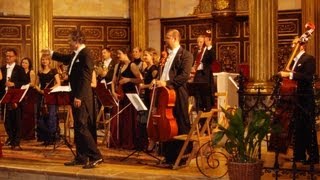
George Frideric Handel ( 1685-1759) was born in Halle , Germany . A naturalized British citizen, he is one of the leading figures in the history of music and, certainly, of the Baroque period . As a child, he began receiving lessons in harmony and counterpoint from Friedrich Zachow , the organist of Halle , with whom he also learned to play the oboe, violin, and organ. At the age of 18, he moved to Hamburg, where he wrote his first two operas. After three years, he traveled to Florence and then to Rome . In 1710, he returned to Germany and from there to London , where he settled for the rest of his life. Despite the complete silence with which he protected his privacy, his homosexuality seems clear. Of his abundant musical output, the oratorio Messiah stands out as one of the masterpieces of music history . He died at the age of 74 at his home.
The sarabande is a musical genre and a very important historical dance in Baroque music, which originated in Latin America (probably in Mexico or Central America ) in the 16th century. Initially, it was a lively, sensual, and rather scandalous dance, to the point of being banned in some places. In Spain, it spread rapidly and retained its festive character. Upon reaching France and Italy in the 17th century , the sarabande became slow, solemn, and elegant, evolving into a typical movement of Baroque suites written in triple meter (3/4 or 3/2) and a slow tempo with a strong accent on the second beat, giving it a grave and majestic character; formally, it frequently appears with two repeated sections.
Sarabande in D minor . This work by George Frideric Handel , especially celebrated for its solemn character, is a perfect example of the slow Baroque dance: solemn, harmonically clear, expressively restrained, and structurally balanced; its popularity stems from this blend of formal simplicity and emotional depth. The work follows the binary form typical of the Baroque suite, with both halves repeated, where Section A presents the main thematic material and establishes the key, while Section B expands and modulates, finally returning to the main key. Furthermore, each section is approximately the same length, a common characteristic of Baroque dances.
Wolfgang Amadeus Mozart (1756-1791) is considered one of the three giants of musical composition, along with Bach and Beethoven . A child prodigy born in Salzburg , Austria, he mastered the keyboard and violin by the age of six and began composing. His father, Leopold, exhibited him on grueling tours of various European courts. A prolific composer (more than 600 works written from the age of five until his death), he cultivated all kinds of musical genres: piano works, chamber music, symphonies, concertos, choral works, operas—each and every one a masterpiece of its kind. His operas The Magic Flute, Don Giovanni, Così fan tutte, and The Marriage of Figaro are among the ten most frequently performed operas in the world. He died in Vienna at the age of 35.
The catalogue of Mozart's works, or Köchel catalogue ( Köchel Verzeichnis in German), was created by Ludwig von Köchel in 1862 and lists the musical works composed by Wolfgang Amadeus Mozart . Each of Mozart 's works is designated by a number preceded by the abbreviation K. or KV ; this number designates the chronological order of its creation and is indeed valid for most of the works. However, the first edition includes works by other composers erroneously attributed to Mozart and omits other authentic works that had not yet been discovered.
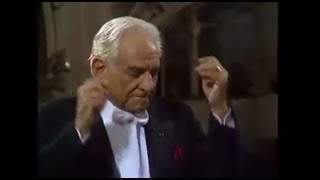
Ave verum corpus is a short musical motet composed by Wolfgang Amadeus Mozart on the eponymous short Eucharistic hymn dating from the 14th century and attributed to Pope Innocent VI . It is numbered KV618 in the Köchel Catalogue of Mozart 's works. The motet, written for choir, strings, and organ, was composed for the Feast of Corpus Christi and completed in Salzburg on June 18, 1791 (the year of his death).
Today it is offered to us by the Bavarian Radio Choir and Orchestra conducted by the American master of masters , Leonard Bernstein .
Edvard Grieg (1843-1907) was a Norwegian composer and pianist, considered one of the leading figures of musical Romanticism. His mother, Gesine , was his first piano teacher; later, he met the legendary Norwegian violinist Ole Bull , a family friend and his mother's brother-in-law. Grieg adapted many themes and songs from his country's folklore, thus contributing to the creation of a Norwegian national identity, much like Jean Sibelius did in Finland or Antonín Dvořák in Bohemia . His most important works include the Piano Concerto in A minor , the intimate Lyric Pieces (for piano), the Holberg Suite (for string orchestra), and, especially, Peer Gynt, incidental music he wrote at the request of the writer Henrik Ibsen for his play of the same name.
Peer Gynt, Op. 23 , is a musical composition for stagecraft, or incidental music, for reciters, vocal soloists, chorus and orchestra by Grieg ; although among the general public the two suites that the author himself wrote, Suite No. 1 Op. 46 and No. 2 Op. 55 , for the play Peer Gynt by the Norwegian playwright Henrik Ibsen , have become more famous.
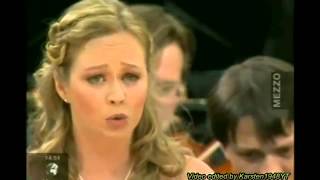
From this incidental work, today we hear the famous Solveig's Song performed by Norwegian soprano Marita Solberg (1976), a singer who has worked with Marc Minkowski, Zubin Mehta, Michel Plasson , and other great conductors. From 2006 to 2008, she was principal singer at the Stuttgart State Opera . She has also performed at the Gran Teatre del Liceu in Barcelona, the Teatro Real in Madrid, the Komische Oper Berlin , and the Norwegian National Opera .
Maria Agata Szymanowska, maiden name Marianna Agata Wołowska (1789–1831), was a Polish composer and pianist. Idolatized in her lifetime and unjustly forgotten after her death, she was one of the first professional female virtuosos of the 19th century . During the 1820s, she traveled extensively throughout Europe before settling permanently in Saint Petersburg . In the Russian imperial capital, she composed for the court, gave concerts, taught music, and ran an influential salon. Her compositions—particularly piano pieces, songs, and other small chamber works, as well as piano études and nocturnes—represent the brilliant style of the pre- Chopin era.
A nocturne is a piece of vocal or instrumental music with a sweet melody and free structure. The term "nocturne" was initially used in the 18th century to refer to a piece played intermittently, usually at evening parties, and then set aside. In its most common form (that is, as a single-movement piece generally written for solo piano), the genre was cultivated primarily in the 19th century . The first nocturnes written under that name were composed by John Field , considered the father of the Romantic nocturne , which features a characteristically lyrical melody with an arpeggiated accompaniment. However, the most famous exponent of this music was Frédéric Chopin , who wrote 21 works in this genre.
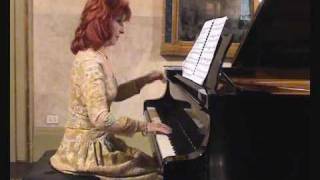
Maria Agata Szymanowska 's Nocturne in B -flat major is one of the most representative works of this pioneer of Romantic piano music and one of the first female pianist-composers with an international career. Although Szymanowska is less well-known today than Chopin , her music was highly influential in the transition between late Classicism and early Romanticism , as Szymanowska 's Nocturne is one of the first works to solidify the nocturne genre, predating Chopin 's celebrated nocturnes . Composed around the 1820s, when the nocturne as a genre was still developing, its style combines Classical elegance with an intimate and ornate lyricism that anticipates the Romantic idiom.
Structure. The work essentially follows a ternary plan A–B–A', typical of the Romantic nocturne, although with a treatment still close to the style of John Field and operatic lyricism. Section A (0'15") – Corresponds to the main theme, which is cantabile, melodic, and intimate in character, with a broad melody adorned with appoggiaturas, mordents, and ornamental turns, and accompanied by regular arpeggios in the left hand, in a harp-like style. Section B (1'15") – A contrasting episode, more dramatic and modulating, though without abandoning the gentleness of the genre, with a less stable texture, harmonic tensions, chromaticism, and a more expressive character, creating an emotional climax before the return to the initial calm. Section A' (1'57") – Return of the original theme, but with ornamental variations: melismas, arabesques, more rubato (stylistically intended but not written) and a slight increase in expressiveness and melodic decoration. Coda (3'10"). Cadence in the main key, with calm and stabilizing ornaments.
The work represents a bridge between late Classicism and early Romanticism , and is a clear and elegant example of the nocturne genre. Today it is presented to us by the Italian pianist Rina Cellini , whose repertoire is vast (ranging from the Renaissance to contemporary music) and who has performed extensively in various ensembles.
Recommended classical music videos
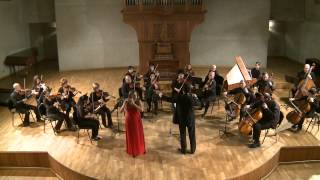
Antonio Vivaldi (1678-1741) was an Italian priest, violinist, and composer known as the Red Priest (“il prete rosso”). Born in Venice , he learned to play the violin from his father as a child. At the age of 15, he entered the seminary , and after his ordination, he was unable to fulfill his religious duties due to health problems. Consequently, he was appointed violin teacher at an orphanage, where he taught both theory and instrumental instruction. At 40, he was appointed Maestro di Cappella in Mantua , where he composed his famous Four Seasons . From there, he moved to Milan , then to Rome , later back to Venice , and finally to Vienna , where he died. Throughout his life, he composed nearly 800 works, half of which were concertos, 40 operas, 60 religious works, and numerous sonatas.
The Ryom Verzeichnis or Ryom Catalogue is a repertoire of the works of Antonio Vivaldi (abbreviated as RV ), compiled by the Danish musicologist Peter Ryom , who published it in 1973. Ryom based the classification not on the chronology of the works, but on three other criteria: the genre , the instruments for which the work was composed, and the tonality .
The piccolo ( from the Italian flauto piccolo: 'small flute') is a woodwind instrument in the key of D-flat and, later, in the late 20th century , almost exclusively in the key of C. It is essentially a small flute. Physically, the piccolo resembles a transverse flute but is smaller. The timbre is similar, but an octave higher. Therefore, the piccolo is considered a transposing instrument; that is, its actual sound differs from the written pitch: the notes to be played on the piccolo are written an octave lower than their actual pitch to avoid using too many ledger lines on the staff.
From the Middle Ages , evidence indicates the use of octave flutes as military instruments, as their penetrating sound was audible above the battlefields. In art music, however, piccolos were first used in some works by Jean-Philippe Rameau in the first half of the 18th century . Even so, the instrument did not begin to spread, and thus to have a stable place in the orchestra, until the early 1800s. During the Baroque period , the designation "flautino" or "flauto piccolo" usually denoted a small recorder (soprano or sopranino). This is particularly true of the concertos that Antonio Vivaldi wrote for piccolo.
The Piccolo Concerto in C major, RV 443 , attributed to Antonio Vivaldi , is one of the three concertos he wrote for flautino (sometimes performed on the modern piccolo). It is one of the most popular works in the repertoire for this instrument due to its brilliance, virtuosity, and typically Vivaldian energy.
Structure . Like almost all of Vivaldi 's concertos, it follows the tripartite scheme (fast-slow-fast): I (0'31") ALLEGRO NON MOLTO. A brilliant and energetic movement, where the soloist moves through rapid passages with very agile scales and arpeggios; a typical example of Vivaldi 's ritornello style with orchestral themes alternating with soloist episodes. II (4'15") LARGO. An expressive and cantabile movement. It contrasts sharply with the outer movements due to its lyrical character, sometimes described as "ethereal" because of its long solo lines over a delicate accompaniment. III (8'25") ALLEGRO MOLTO. A lively, playful, and highly virtuosic movement that requires precision and lightness of touch from the performer. In this way, it closes the concerto with a festive character.
Today we have Sara Urena-Cabrera as our soloist, accompanied by the Armenian National Chamber Orchestra , conducted by Maestro Harutyun Arzumanyan .
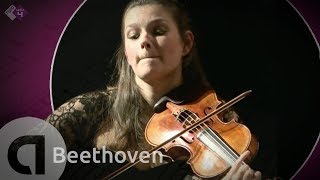
Ludwig van Beethoven (1770–1827), together with Bach and Mozart, forms part of the trio of giants of Western music. Born on December 16, 1770, in Bonn, his father, of Flemish origin, attempted to present him as a second Mozart, although this proved to be a notable failure. Despite this, from the age of nine the organist Christian Gottlob Neefe inspired him through the study of Bach, whom Beethoven would always hold in high regard. In 1787 he moved to Vienna intending to study with Mozart, but the death of his mother forced him to return to Bonn after only a few days. Then, five years later, he returned to Vienna, where he was able to study with Haydn and Salieri. However, his career as an outstanding pianist could not fully develop because of the deafness that struck him the following year, eventually leaving him completely deprived of that faculty.
Beethoven’s musical legacy includes 32 piano sonatas, numerous chamber works, piano and violin concertos, incidental music, sacred music, and above all nine symphonies that represent the pinnacle of Music History. To better understand this legacy, it can be divided into three stages of continuous renewal and achievement:
A) Until 1802. Classicism. This period includes his first ten piano sonatas, first six string quartets, the Septet, the first two symphonies, and the first two piano concertos.
B) 1803–1814. Romanticism. At the height of his artistic maturity, and with complete mastery of formal structure and lyricism, he composed Symphonies Nos. 3 to 8, his opera Fidelio, Piano Concertos Nos. 3, 4, and 5, the Violin Concerto, the Triple Concerto, the piano sonatas Moonlight and Appassionata, the Kreutzer Violin Sonata, among others.
C) 1815 until his death. Innovation of a more intense musical language, with bolder harmonic and structural treatment: the last five piano sonatas and last five string quartets, Symphony No. 9 with the incorporation of soloists and chorus, the Missa Solemnis, etc.
The catalogue of Beethoven’s works. There are 138 musical works composed by Beethoven, organized by numbers known as opus (“work” in Latin), or by the abbreviation op., assigned by the composer’s publishers during his lifetime. In addition, there are another 205 works without opus numbers that were published after the composer’s death. These works were assigned WoO numbers (Werke ohne Opuszahl, “works without opus number”). This catalogue was first compiled by Georg Kinsky and Hans Halm (Das Werk Beethovens) in 1955.
The Septet in E-flat major for clarinet, horn, bassoon, violin, viola, cello, and double bass, Op. 20, by Ludwig van Beethoven, was sketched in 1799, completed and premiered in Vienna in 1800, and published in 1802. The score bears the inscription: “Der Kaiserin Maria Theresia gewidmet” (“Dedicated to Empress Maria Theresa”). It was one of Beethoven’s most popular works during his lifetime, much to the composer’s dismay. Several years later, Beethoven even wished the score destroyed, saying: “That cursed work! I wish it were burned!” The Septet was extremely popular, especially in Paris, where it was performed for decades, often more than once a year by members of the Orchestra of the Société des Concerts du Conservatoire.
Its overall structure resembles a serenade and is in fact almost identical to Mozart’s String Trio, K. 563, in the same key; however, Beethoven expanded the form by adding substantial introductions to the first and last movements and transforming the second minuet into a scherzo. Beethoven had already used the theme of the third movement in his Piano Sonata Op. 49 No. 2, a work composed earlier despite its higher opus number. The finale includes a violin cadenza. The orchestration of the Septet for a single clarinet, horn, and bassoon (instead of pairs of these wind instruments) was innovative, as was the unusually prominent role of the clarinet, which is as important as the violin. The composition consists of six movements:
I (0’03’’) ADAGIO – (1’23’’) ALLEGRO CON BRIO (in E-flat major)
II (10’57’’) ADAGIO CANTABILE (in A-flat major)
III (20’47’’) TEMPO DI MENUETTO (in E-flat major)
IV (24’02’’) TEMA CON VARIAZIONI: ANDANTE (in B-flat major)
V (31’35’’) SCHERZO: ALLEGRO MOLTO E VIVACE (in E-flat major)
VI (34’42’’) ANDANTE CON MOTO ALLA MARCIA (in E-flat minor) – (35’43’’) PRESTO (in E-flat major).
Today it is performed for us by the septet formed by Janine Jansen (violin), Dana Zemtsov (viola), Jens Peter Maintz (cello), Stacey Watton (double bass), Martin Fröst (clarinet), Jasper de Waal (horn), and Fredrik Ekdahl (bassoon).
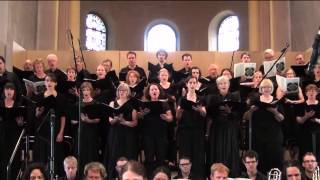
Felix Mendelssohn (1809-1847) was a German pianist, conductor, and composer of outstanding technical and formal perfection. A child prodigy who displayed extraordinary abilities at a very young age, he was the brother of pianist and composer Fanny Mendelssohn , also a child prodigy . He began receiving piano lessons from his mother; at eighteen, he began studying composition, using Bach 's Well-Tempered Clavier as a foundation. Thus, Mendelssohn 's works exhibit a well-established tonal clarity and a profound mastery of counterpoint. His legacy includes piano music, organ music, chamber music, overtures, symphonies, concertos, oratorios, and incidental music.
Lauda Sion is one of the great liturgical motets/sequences set to music by Felix Mendelssohn ; it is, in fact, a liturgical sequence for the feast of Corpus Christi . In this case, Mendelssohn composed it in 1846 at the request of the Liège Cathedral chapter, on the occasion of the 600th anniversary of the original composition of the medieval text Lauda Sion Salvatorem . The literary text was popularized by Saint Thomas Aquinas in 1264, when Pope Urban IV instituted the feast of Corpus Christi . Mendelssohn set this text entirely to music as a work for vocal soloists, mixed choir, and orchestra, and it premiered in Liège on June 11, 1846, since the city claimed to be the birthplace of the feast of Corpus Christi . Lauda Sion is one of the most important liturgical works of late Mendelssohn , aesthetically close to his Elijah .
Structure . I (0`00``) CHORUS, ANDANTE MAESTOSO. Lauda Sion Salvatorem .-. II (6` 32`) CHORUS, WALKER WITH MOTORCYCLE Laudis thema specialis .-. III (9`22`) SOPRANO SOLO AND CHORUS, SOSTENUTO. Sit laus plena, sit sonido .-. IV (12`01``) QUARTETTO, ANDANTE. In hac mensa novi Regis .-. V (16`07``) CHOIR, BASS. Docti sacris institutis Panem .-. VI (18`56``) CHORUS, ALLEGRO MAESTOSO. Sub diversis speciebus .-. VII (21`40``) SOPRANO SOLO, ANDANTE Caro cibus .-. VIII (24`45``) CHORUS, BASS Sumit unus .-. IX (27`50`) QUARTETTO E CORO, ANDANTE MAESTOSO Ecce panis Angelorum .-. X (31`38``) QUARTETTO E CORO, ALLA BREVE NON TROPPO ALLEGRO Bone pastor... Amen.
Today it is offered to us by the Madrigal Choir of Würzburg with the Bad Kissingen Chamber Orchestra conducted by the German maestro Jörg Wöltche .
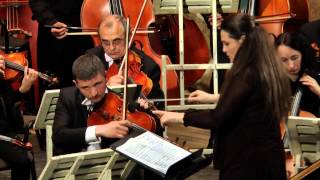
George Enescu (1881-1955) was a Romanian composer, violinist, pedagogue, pianist, and conductor, considered one of his country's most important musicians, with a career deeply connected to France . Between 1888 and 1894, he studied at the Vienna Conservatory , quickly adapting to the city's vibrant musical life. His concerts, featuring works by Brahms, Sarasate, Vieuxtemps , and Mendelssohn , captivated the press and public. He was only 12 years old at the time. After graduating from the Vienna Conservatory , he continued his studies at the Paris Conservatory . In 1898, he made his debut as a composer in Paris . That same year, he began conducting concerts in Bucharest and giving violin recitals.
George Enescu 's two Romanian Rhapsodies, Op. 11 for orchestra, were written in 1901 and first performed together in 1903; both employ elements of lăutărească (Romanian gypsy) music, vivid Romanian rhythms, exotic modal colors, with some scales having 'movable' thirds, sixths or sevenths, creating a changing major/minor atmosphere, one of the characteristics of Romanian music.
George Enescu 's Romanian Rhapsody No. 1 in A major is one of his most celebrated works and a brilliant example of how he transformed Romanian folklore into a symphonic piece, in which the essence is dance. Enescu claimed that it was "just a few melodies thrown together without thinking about it"; but his sketches show that he carefully worked out the order in which the melodies should appear and their instrumental arrangement. He completed it on August 14, 1901, when Enescu was only 19 years old.
Its structure is relatively simple, yet highly effective: it functions as a large free rondo form or orchestral fantasy based on a succession of folk dances and melodies, developed with increasing energy and arranged in three large, recognizable sections: I (0'07") INTRODUCTION. Exposition of the main theme (slow and melodic), which begins lyrically and gently, presented by the clarinet. This theme derives from the folk song " Am un leu şi vreau să-l beau, " embellished with an improvisational character, almost like a lăutar (folk musician) playing, as a base theme upon which variations and episodes will be built. II (2'10") CENTRAL SECTION. This is the longest section. Enescu introduces and links a series of folk themes, each with a characteristic rhythm and color; new melodies emerge one after another, as if it were a medley . The rhythms are reminiscent of traditional Romanian dances: Sârba (lively, in fast time), Hora (circular dance), Călușarii , etc. The orchestra gradually becomes more animated, with changes in orchestration, modes, and accelerations, creating an increasingly lively character and an atmosphere of a peasant festival. III (9'06") CODA. The work enters a continuous acceleration (stringendo), typical of Romanian fiddler music (traditional violin ensembles), in which earlier motifs reappear, now brilliantly and intensely, culminating in a dizzying, almost pyrotechnic, orchestral finale.
Today it is presented to us by the Moldovan National Philharmonic under the baton of Canadian maestro Silvia Tabor
Recommended music videos for all tastes
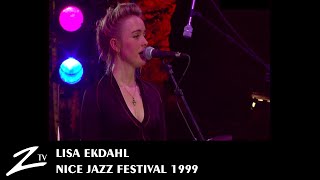
Lisa Ekdahl (Stockholm, 1971) is a Swedish singer who primarily uses English in her jazz work and Swedish in her other songs. She is characterized by her high-pitched and very smooth voice. In the 1990s, she became one of the leading figures in Swedish pop . In 1994, her self-titled debut album was released in Sweden , and her single "Vem Vet" made her a superstar in Scandinavia at the age of 23. The singer's first English-language effort was 1998's *When Did You Leave Heaven* , which was also her first jazz album and her first album released in the USA . It became a critical and commercial success in Sweden and throughout Europe . The following year, she released her second English-language album, *Back on Earth *, which has since established her as one of the great contemporary jazz singers.
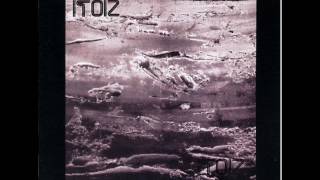
Itoiz was a Basque rock band formed in the area around Mutriku ( Gipuzkoa ) and Ondarroa (Bizkaia) in 1978, although its origins actually went back further; it emerged from a local festival band called Indar Trabes , which included all the future members of Itoiz . As Indar Trabes, they were quite well-known in the Basque Country ; however, this very fact led them to decide against using that name for their album, as the public might assume their music was the same as what they played at village dances.
Their first album, 'Itoiz' ( Xoxoa , 1978), is an absolute marvel. The fact that they sang in Basque made it difficult for the general public to accept them elsewhere. The lineup was: Juan Carlos Pérez (vocals and guitar), José Garate "Foisis" (bass and vocals), Antton Fernández (keyboards), Joseba Erkiaga (flute), and Estanis Osinalde (drums), in addition to their manager , Angel Azkarraga , who was also listed as a member on this first album. All the music is by Pérez , while the lyrics are by Pérez , Azkarraga , and two poet friends of the group: Joseba Alkalde and Joseba García .
The album Itoiz, which we are presenting today, has a strong folk influence , a touch of jazz , and a good deal of progressive rock. Acoustic songs like 'Zati txiki bat la m'en' or 'Lau teilatu' , jazzy tracks like 'Astelehen urdin batean' , rock songs like 'Foisis jauna ' ( Foisis was Gárate 's nickname), and clearly progressive songs like 'Hilzori' or 'Goizeko deihadar' . Of all of them, 'Lau teilatu' would become the band's anthem, a song that became very well-known in the Basque Country and catapulted them to success. Interestingly, the lyrics tell of two friends who meet at village festivals, a clear reference to the group's past involvement with these local celebrations. These are the songs from the album we are presenting today: I (0`00``) Phuntzionariat .-. II (3`44``) Goizeko deiadar .-. III (13`48``) Zati txiki bat .-. IV (15`46``) Lau teilatu .-. V (19`53``) Hilzori .-. VI (31`47``) Foisis jauna .-. VII (35`05``) Astelehen urdin bat
The group disbanded due to its members' military service, and its leader, Juan Carlos Pérez , decided to continue releasing several high-quality albums, both solo and with some of his former bandmates and even studio musicians hired for the occasion, until 2000, when Juan Carlos definitively retired from the popular music scene, thus making Itoiz history. ( Excerpted from the Nueva Ola article )

Lana Del Rey (1985) is an American singer, songwriter, model, and producer. Her music is distinguished by its stylized quality, retro style, themes of tragic romance, glamour, and melancholy, and its references to 1950s and 1960s American pop culture. She began performing in New York clubs at the age of 18, though success would take another six years to arrive; it came when she was 26 with the album *Video Games *. From then on, she began to gain recognition, and her single "Summertime Sadness" reached the top ten on the Billboard Hot 100. Del Rey has received numerous awards, including two Brit Awards , two MTV Europe Music Awards , a Satellite Award , and nine GAFFA Awards. She has also been nominated for five Grammy Awards and one Golden Globe Award .
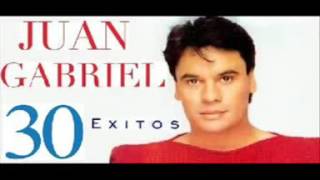
Juan Gabriel (1950-2016), whose real name was Alberto Aguilera Valadez , was a Mexican singer-songwriter and actor, considered one of the most successful artists in Latin America , as well as one of the most influential composers and singers in the Hispanic music industry. His total sales are estimated at over 150 million albums and singles worldwide, making him one of the best-selling Latin artists in history. His work encompasses more than 1,800 compositions that have been translated into languages as diverse as Turkish, German, French, Italian, Tagalog, Japanese, Greek, Papiamento, Portuguese, and English, and performed by more than 1,500 artists and groups around the world, making him the most sung and covered Hispanic composer globally. He was posthumously inducted into the Latin Songwriters Hall of Fame in 2016. In 1999, Billboard magazine recognized him as "The Latin Legend " and published a special edition acknowledging his musical contributions and the impact of his songs on Latin culture in the United States and worldwide. His discography has been awarded more than 1,500 gold, platinum, multi-platinum, and diamond records. In 2016 , he achieved another record, placing Los Dúo 2 at #1, Los Dúo at #2, and Mis 40 en Bellas Artes at #3, making him the only living artist to accomplish this feat.
He was also known for his work providing development opportunities for underprivileged children, not only in Mexico , but also in Venezuela and other countries. He directly supported over a hundred children at a school called " Semjase" in Ciudad Juárez, Chihuahua . He died at the age of 66 from an acute myocardial infarction while on his " MeXXico es Todo " tour. His remains were taken to the Palace of Fine Arts , where he was honored by more than 700,000 people and a television audience of 11.8 million, making it one of the most attended events and funerals in the country's history.
Recommended peculiar videos
Alexander Borodin (1833-1887) was a Russian physician, chemist, and composer, a member of The Five , and a staunch advocate for women's rights . He was a champion of education in Russia and the founder of a medical school for women. The illegitimate son of Russian Prince Luka Stepanovich Gedevanishvili , he enjoyed a comfortable and well-educated youth. He studied piano, cello, and flute independently, and at the age of 15 enrolled in the Faculty of Medicine, specializing in chemistry , a profession he would practice for the rest of his life. At 30, he began studying composition with Balakirev and, as an amateur, wrote chamber music and some religious works, three symphonies, the poem "In the Steppes of Central Asia," and the opera "Prince Igor."
Prince Igor is an opera by Alexander Borodin , inspired by the campaign of Prince Igor of Kyiv against the Polovtsy or Cumans of Khan Kontckak , based on a 12th-century epic poem, " The Tale of Igor's Campaign ." An unfinished opera when Borodin died in 1887, it was completed by Nikolai Rimsky-Korsakov and Alexander Glazunov and premiered on November 4, 1890, at the Mariinsky Theatre in St. Petersburg .
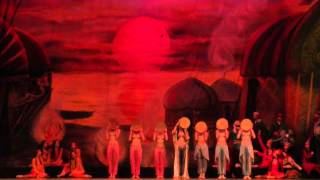
The Polovtsian Dances are a suite of oriental dances included in Act Two of the opera. They represent a spectacular choreographic scene presented by the Polovtsian leader , Khan Konchak , to entertain Prince Igor , who has been captured. These dances are one of the most famous parts of the entire opera and a brilliant example of the musical exoticism that characterizes certain 19th- century Russian composers. Today they are performed by the Imperial Russian Ballet .
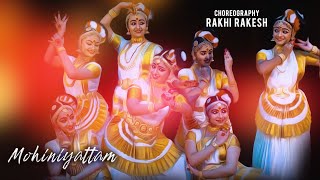
Mohiniyattam is one of India 's classical dances, originating in the state of Kerala . Its name comes from "Mohini" (the enchantress, a female incarnation of Vishnu) and "attam" (dance), so it is often described as the dance of the enchantress. Its style is gentle and undulating, with fluid movements reminiscent of swaying palm trees or ocean waves. Elegance and subtle facial expressions, along with emotional and expressive storytelling, predominate in the dance, rather than leaps or energetic movements. The body typically maintains a slight inclination to one side, creating a curved silhouette characteristic of the style. Regarding attire, a white or ivory sari with gold trim, typical of Kerala , is generally worn. Makeup is understated, and the hair is styled in a side bun adorned with jasmine flowers. Hand gestures (mudras) and eye movements play a fundamental role in the expression.
Traditionally, Mohiniyattam depicts stories of love, devotion, or episodes from Hindu mythology. The female figure is central, and the dance typically conveys refined emotions such as love, separation, or spiritual devotion. It is believed to have taken shape between the 15th and 16th centuries , with strong influences from the Kerala temple style. It was systematized and revitalized in the 20th century by key figures such as Kalamandalam Kalyanikutty Amma , considered the mother of modern Mohiniyattam .
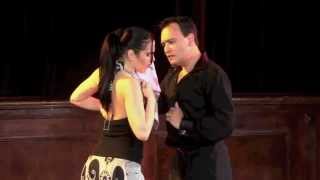
The Zamba is a dance from northern Argentina that originated in Peru. The term " zamba " refers to individuals of mixed race, the offspring of an Indigenous American and a Black person. Its choreography consists of three main elements: a) Full turn : the dancers begin each in their own place, passing through their partner's; this is completed by returning to their starting position. b) Half turn : the dancers move from one position to another (changing places), thus describing a semicircle. c) Arrest (or "Festejo"): the dancers' movements are generally performed in the central space, with turns in both directions, where the man typically crowns the woman with a handkerchief. These elements are combined in two sections of the score, which are indicated lyrically by the musicians: "First!" and "Second!"
Of a calm and majestic nature, it is interpreted by a mixed couple; in this case by Georgina Vargas and Oscar Mandagaran .
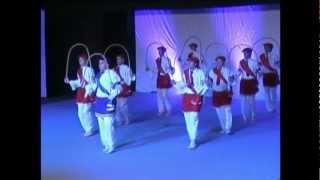
Basque dances , in Basque Euskal Dantzak , are a very important part of Basque culture and a fundamental element of its folklore. Each historical territory, or province, has its own, and each town also has its own dance, traditionally performed at its main festivals. Some of these dances are very ancient, their origins lost to time; others are more or less modern recreations of old dances; and some are new choreographies with a folk basis.
Oñati Arch Dance. The most important festival in Oñati , Gipuzkoa , is Corpus Christi . In the morning, after High Mass , a procession takes place with the holy figures and the dancers, who dance again in the afternoon. One of the dances is the Arku Dantza (Arch Dance), very impressive for its rhythm and changes. ( Excerpted from the caption of this video )
Today we offer it through the Itxas Alde Dantza Taldea group.
Recommended music videos for children





Various Wikipedia articles and relevant information on Artificial Intelligence were used to prepare these texts.
The texts of Videomusicalis are written in Basque, Spanish and English.