

Recommended music videos for initiation to classical music



Josquin des Prez (1450–1521), also known as Josquin Després , was a Franco-Flemish composer of the Renaissance , considered the most famous European Renaissance composer along with Guillaume Dufay, Tomás Luis de Victoria, and Giovanni Pierluigi da Palestrina . He is commonly regarded as the central figure of the Franco-Flemish school and widely considered the first master of the High Renaissance style of polyphonic vocal music. During the 16th century , he gained renown as the greatest composer of the era, whose masterful technique and expression were universally imitated and admired. At least 374 works are attributed to him, encompassing both sacred and secular music in all the significant vocal forms of the period, including masses, motets, chansons, and frottoles .
The Frottola was a very popular Italian vocal genre in the late 15th and early 16th centuries, characterized by having the text in the vernacular (Italian) expressed with light, simple music of a humorous or amorous nature and with a predominantly homophonic texture (all voices advance together).
"The Cricket" is one of Josquin's most emblematic frottolas , with a text that humorously describes a cricket that sings incessantly, especially in hot weather; a cricket that doesn't stop once it starts and is almost a "better singer" than other birds. The poem is light, humorous, and has an almost cartoonish tone. The music imitates the cricket's persistent chirping through repetitive patterns, while the voices move together, making the piece accessible and catchy, with some phrases seeming to mimic the trill or vibrato of an insect. It is a cheerful piece with a simple structure typical of the frottola , featuring repeated sections of a comic nature; this contributes to "The Cricket" being one of Josquin 's most widely known works outside of his sacred compositions.
Today we offer the version offered by the American male vocal octet (“otxote”) Cantus .
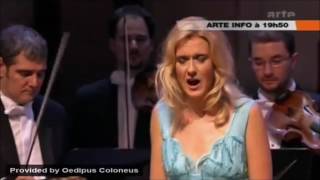
George Frideric Handel ( 1685-1759) was born in Halle , Germany . A naturalized British citizen, he is one of the leading figures in the history of music and, certainly, of the Baroque period. As a child, he began receiving lessons in harmony and counterpoint from Friedrich Zachow , the organist of Halle , with whom he also learned to play the oboe, violin, and organ. At the age of 18, he moved to Hamburg, where he wrote his first two operas. After three years, he traveled to Florence and then to Rome . In 1710, he returned to Germany and from there to London , where he settled for the rest of his life. Despite the complete silence with which he protected his privacy, his homosexuality seems clear. Of his abundant musical output, the oratorio Messiah stands out as one of the masterpieces of music history . He died at the age of 74 at his home.
The aria "Lascia ch'io pianga ," which we present today, is an aria from the opera Rinaldo , which was previously used under the title " Lascia la spina" in the oratorio Il trionfo del tempo e del disinganno . The performance is by in charge of the French soprano Patricia Petibon considered an exceptional singer of French baroque music.
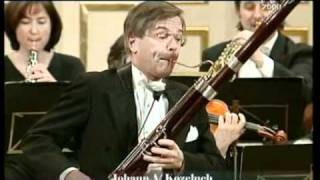
Johann Antonin Kozeluch (1738–1814) was a Czech composer, Kapellmeister, and music teacher, and a cousin of Leopold Koželuh . A prominent Bohemian composer of the second half of the 18th century , his music was highly regarded by his contemporaries and remained popular well into the 19th century . During his lifetime, he was considered a "masterful contrapuntist," as he frequently employed polyphonic forms in his sacred works, written primarily during the early and late periods of his compositional activity. In these works, he reduced the role of solo and virtuosic vocal parts to give prominence to harmonic and contrapuntal expression. In the intervening period, he focused primarily on opera: he was the second Czech composer to stage his own operas in Prague . The first was Josef Mysliveček . His bel canto works follow the canons of opera seria typical of Niccolò Jommelli 's works, namely the alternation of recitatives and arias (in the reduced form of the da capo aria ), also employing accompanied recitatives. In addition to his extensive vocal repertoire, he wrote several concertos for oboe, clarinet, and bassoon.
Bassoon Concerto in C major . Although not as widely known as Mozart 's Viennese concertos, Koželuch 's concerto is a characteristic work of the early-late Classical style : formal clarity, melodic elegance, and a virtuosic but not excessive use of the solo instrument. This concerto, structured in three movements, as was common at the time, is an excellent example of early Viennese concert music, combining Classical elegance with a highly idiomatic use of the bassoon, offering both lyricism and virtuosity without excess.
Movement III : Rondo ( Allegro ). This is a playful and lively movement, in the form of a rondo typical of the early Classical period : fresh, light, and virtuosic. Its main theme ( refrain) is very danceable, with dotted rhythms and an almost folk-like character, while the episodes offer modulatory contrasts and allow the bassoon to display its agility through rapid passages articulated with descending scales typical of the instrument and intervallic leaps that exploit its flexibility. For all these reasons, the bassoon has moments of great brilliance, especially in rapid sixteenth notes and sequential patterns, while also maintaining a consistently transparent balance with the orchestra, avoiding any density that might obscure the soloist.
Today it is offered to us by the Austrian bassoonist Milan Turkovic , accompanied by the Camerata Academica Salzburg conducted by Maestro Alexander Janiczek .
José Pablo Moncayo (1912-1958) was a Mexican composer who represents one of the most important musical legacies of Mexican nationalism, alongside Silvestre Revueltas, Carlos Chávez , and Julián Carrillo . His teachers were Candelario Huízar and Carlos Chávez , in harmony and composition respectively. During his student years, he was forced to play piano in cafes and radio stations to pay for his studies, until he joined the National Symphony Orchestra as a percussionist. According to Yolanda Moreno Rivas : “ Moncayo ’s death in 1958 brought an end to the dominance of a compositional style whose influence marked musical creation in Mexico for more than three decades.”
Huapango is Moncayo 's best-known work, to such an extent that in that country it has been called the second Mexican National Anthem ; it is a work inspired by the Veracruz sones that he studied during a visit to the port of Alvarado , Veracruz , and which includes melodic and rhythmic motifs from several sones among which the most evident are "El Siquisiri", "El Balajú" and "El Gavilancito" .
Today it is directed by Alondra de la Parra (1980), an internationally renowned Mexican conductor who is currently the head of the Queensland Symphony Orchestra ; she was the first woman in Australia to hold a position in this organization.
Recommended classical music videos

Juan Crisóstomo de Arriaga (1806-1826), known by many as the Basque Mozart , was born in Bilbao . His father, Juan Simón , came from Errigoiti , a town near Gernika , as did his mother, Maria Rosa . His father, an organist in Berriatua, Bizkaia , moved to Bilbao to pursue his business interests, which prospered, allowing him to support Juan Crisóstomo 's education in Paris, where he died ten days before his twentieth birthday. The musical legacy that has survived consists of three string quartets, the octet "Nada y mucho" (Nothing and Much ), written when he was eleven, Overture No. 1 , the Symphony in D, several arias and cantatas, as well as some motets and an opera, "Los esclavos felices" (The Happy Slaves ), written when he was thirteen, of which only the overture survives.
Juan Crisóstomo de Arriaga 's String Quartets are a collection of three quartets for two violins, viola, and cello, composed in 1823 when the composer was only sixteen years old. These three quartets , structured in four movements, were the only work the composer saw published during his lifetime and display a surprising technical and expressive maturity, especially considering his short life. Arriaga 's quartets are considered among the most outstanding quartets written during the Classical/Early Romantic period.
Juan Crisóstomo de Arriaga 's Quartet No. 1 in D minor is one of the best-known works of the young composer from Bilbao; a work that follows the classical model inherited from Haydn and Mozart , with clear influences from Beethoven and structured in four movements: I (00:03) ALLEGRO. A dramatic and energetic movement with the use of short motifs that are developed with great skill, through the use of contrast between tension and lyricism. II (07:24) ADAGIO CON ESPRESSIONE. A lyrical movement, of great melodic sensitivity. Arriaga demonstrates here a remarkable mastery of expression and cantabile writing. III (13:20) MENUETTO. ALLEGRO – TRIO. MODERATO. A movement closer to a Beethovenian scherzo than to a classical minuet with lively rhythms and contrasting sections. IV (17:00) ADAGIO - ALLEGRETTO. This is a brilliant and virtuosic final movement, conveying a sense of continuous momentum, with a bolder harmonic language.
Today's performance is by the Óscar Esplá Quartet of Asisa, made up of Raquel Areal Martínez (violin), Patricia Cordero Beltrán (violin), Raquel De Benito Forriol (viola) and Montserrat Egea (cello).
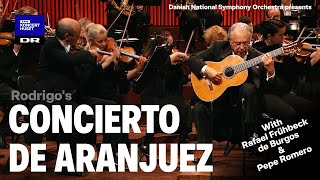
Joaquín Rodrigo (1901-1999) was a Spanish composer born in Sagunto ( Valencia ). He became blind at the age of seven; at nine, he began his studies in solfège, violin, and piano; at 16, harmony and composition; and at 22, he began composing his first works. At 26, he moved to Paris , where he studied with Paul Dukas for five years. In 1940, he premiered the Concierto de Aranjuez in Barcelona , which from then on would become world-renowned. He was a prolific composer who wrote works for solo instruments, for piano with another instrument, for string orchestra, wind orchestra, and symphony orchestra, concertos for various instruments, songs, symphonic-choral works, and stage music, always maintaining the clarity, delicacy, and distinction characteristic of his music.
The Concierto de Aranjuez is Rodrigo 's most famous work and the one that brought him worldwide acclaim; a work that attempts to transport the listener to the sounds of nature from another place and time; a work structured in three movements: I (0'09") ALLEGRO CON SPIRITO. According to the composer, the first movement is "animated by a rhythmic spirit and vigor without either of the two themes... interrupting its relentless rhythm." II (6'58") ADAGIO. A particularly popular movement that has been performed by numerous opera and popular singers; a movement that "represents a dialogue between the guitar and the solo instruments" (English horn, bassoon, oboe, French horn). III (18'29") ALLEGRO GENTILE. A movement that "recalls a formal dance in which the combination of a double and triple rhythm maintains a tense tempo close to the next bar." The Concerto was written in 1939 in Paris and was the first concerto he wrote for guitar; its premiere took place the following year at the Palau de la Música Catalana in Barcelona with guitarist Regino Sáinz de la Maza (1896-1981). The composer describes the concerto as capturing "the fragrance of magnolias, the song of birds, and the spray of fountains" in the gardens of Aranjuez .
Today it is presented to us by guitarist Pepe Romero accompanied by the Danish National Symphony conducted by maestro Rafael Frühbeck de Burgos .
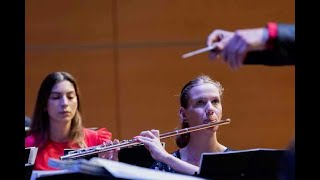
Sandra Stadler is a Swiss composer and pianist who studied piano and composition (Bachelor's degree) and then completed a Master's degree in composition for film, theater, and media at the ZHdK (Zürcher Hochschule der Künste — Zurich University of the Arts). In addition to composing film music, she also creates concert music for diverse ensembles. Furthermore, Stadler not only composes but also performs as a pianist, singer, and songwriter. She co-founded the film music production company SONDER Film Music with another musician . Her work is characterized by a combination of emotional sensitivity and musical depth: while sounding accessible, it possesses musical depth and manages to immerse both performers and audiences in emotion. Stadler moves with ease between concert music and film composition. This versatility—from solo piano and vocal pieces to film scores—makes her a truly complete artist.
Heavy is an original composition written by Sandra Stadler specifically for the Swiss Symphonic Wind Orchestra (SSWO) , a recently founded symphonic wind ensemble of Swiss musicians. The work was commissioned and premiered by the ensemble during one of its first programs, quickly becoming a staple of its contemporary repertoire. Heavy blends contemporary classical music with elements of pop-rock, giving it a hybrid and energetic character. While it includes softer passages, it is primarily composed as a loud and powerful piece, taking full advantage of the orchestra's impressive sound. Stadler designed the work to leverage the Swiss Symphonic Wind Orchestra 's sonic mass and power to convey a sense of breaking boundaries, of strength and energy.
The Swiss Symphonic Wind Orchestra (SSWO) presents Heavy today. The SSWO is a relatively new Swiss ensemble that combines professional musicians and dedicated amateurs with the aim of performing and promoting wind orchestra music, including contemporary Swiss works. Heavy was one of the first compositions created specifically for this group, reinforcing its commitment to innovative repertoire.
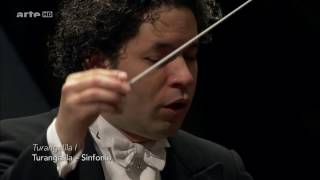
Olivier Messiaen (1908–1992) was a French composer, organist, pedagogue, and ornithologist, one of the most outstanding musicians of the 20th century. His fascination with Hinduism, his admiration for nature and birds, his deep Christian faith, and his love of instrumental color were all fundamental to his development as a person and an artist. He entered the Paris Conservatory at the age of 11, where his teachers included Paul Dukas, Marcel Dupré, Maurice Emmanuel , and Charles-Marie Widor . He was appointed organist at the Church of the Holy Trinity in Paris in 1931, a position he held until his death. In 1941, he was appointed professor of harmony, and in 1966, professor of composition at the Paris Conservatory , a position he held until his retirement in 1978.
The Turangalila Symphony , a large-scale work structured in 10 movements linked by a series of recurring musical themes and ideas, resembles a piano concerto and Ondes Martenot . It requires 103 musicians with a wide range of percussion and keyboards, and its duration is approximately 80 minutes. Olivier Messiaen composed it for the Boston Symphony Orchestra , and the work is considered one of the masterpieces of 20th-century classical music. In the composer's words, "The title comes from the two Sanskrit words, turanga and lila , and can be freely translated as 'song of love and hymn to joy, time, movement, rhythm, life, and death.'"
Structure. 0:00:05 I. Introduction. Modéré, un peu vif 0:06:53 II. Chant d'amour 1, Modéré, lourd 0:15:04 III. Turangalîla 1, Presque lent, rêveu 0:20:56 IV. Chant d'amour 2, Bien modéré 0:31:46 V. Joie du Sang des Étoiles, Vif, passionné avec joie 0:38:28 VI. Jardin du Sommeil d'amour, Très modéré, très tendre 0:49:14 VII. Turangalîla 2, Un peu vif, bien modéré 0:53:01 VIII. Développement d'amour, Bien modéré 1:04:37 IX. Turangalîla 3, Bien modéré 1:10:13 X. Final, Modéré, presque vif, avec une grande joie.
The version we present today is performed by La Orchestre Philharmonique de Radio France conducted by Susanna Mälkki with Roger Muraro on piano and Cynthia Millar on Ondes Martenot.
Recommended music videos for all tastes

Estrella Morente (1980), a flamenco singer born into a family deeply rooted in flamenco , was a devoted fan of flamenco singers such as La Niña de los Peines, Camarón, Marchena, and Vallejo . At the age of four, she was singing songs from Levante , and by seven, she had performed a taranta accompanied by the guitar of the maestro Sabicas . She debuted at 16 at a gala event for the Sierra Nevada ski championships. Since then, she has recorded several gold and platinum records, received numerous prestigious awards, and performed at major festivals. Her artistry has captivated both the most discerning flamenco scholars and rock stars like Lenny Kravitz . In 2001, she was named Ambassador of Andalusia , and in 2014, she became director of the world's first Chair of Flamencology.

Scorpions is a German hard rock and heavy metal band founded in Hanover in 1965. Throughout their more than fifty-year career, they have received numerous awards and accolades, making them the most successful rock band in Germany and continental Europe . In 2011, the German music press estimated that the group's sales reached 160 million records worldwide, and during the official presentation of the 2009 Echo Awards, it was mentioned that they had, up to that point, given more than 5,000 live concerts in over eighty countries. Furthermore, by 2015, their albums had been certified more than thirty-five times platinum and more than one hundred times gold .

Nazia Hassan (1965–2000) was a Pakistani singer, songwriter, lawyer, political analyst, and philanthropist. Known as the " Queen of Pop of South Asia ," she is considered one of the most influential musical figures in South Asian history and the subcontinent 's first pop star . From the 1980s onward, as part of the duo Nazia & Zoheb , she and her brother Zoheb Hassan sold over 65 million records worldwide. Born in Karachi, Pakistan , she was raised between Karachi and London , where she studied alongside her brother Zoheb Hassan. There, they were directly influenced by the maestro Suhail Sana , who produced their musical show Saray Dost Hamaray (" Everyone Is Our Friend" ). Years later, on March 22, 2002, he received posthumous recognition for his contributions and achievements from the Government of Pakistan , which awarded him the highest prize for civic achievement and pride in the area of culture, art, and music.

Jere Klein (real name Jeremías Benjamin Tobar ) is a Chilean singer and songwriter, born on March 4, 2006, in the Santa Anita neighborhood of the Lo Prado district in Santiago, Chile. From a young age, he showed an interest in music and the urban genre. In his early days, starting at age 14, he only released mambo remixes or made appearances in music videos of the genre. In 2020, he collaborated with Bayriton, Dylan el Menor, and Ortega de la M. on the single " Me la busqué ." That same year, he participated in the song " Puesto para la acción " with Jairo Vera and urban artists Bayriton and Lushito FlowMii . After a dozen collaborations with various artists in the Chilean urban music scene, he achieved greater recognition in 2022 with his song " Estoy volando alto " and gained popularity through the TikTok platform. In 2023, he achieved widespread recognition with the release of his EP , " 6.5, " which earned Jere Klein his first number one hit on Spotify 's charts, thanks to the song " Dos hielos ." On December 1, 2023, he released his debut album, Énfasis , featuring the song "Ando," which surpassed 200 million views on YouTube , propelling him to fame. The album garnered over three million streams in a single day, becoming the best debut ever for a Chilean artist on Spotify .
Recommended peculiar videos

Nikolai Rimsky-Korsakov (1844-1908) was a Russian composer belonging to The Five (a group comprised of Balakirev, Borodin, Cui, Mussorgsky, and Rimsky-Korsakov himself), who shared the common goal of promoting distinctively Russian music, moving away from European musical influences and fostering musical nationalism. Rimsky 's works are considered benchmarks of varied, colorful, and balanced orchestration and are highly regarded among the most representative of the orchestral repertoire; all within the framework of his nationalist creed, which encouraged the incorporation of motifs, rhythms, and songs from Russian folklore into his compositions.
Scheherazade , Op. 35 , is a symphonic suite by Rimsky-Korsakov , premiered in St. Petersburg on November 3, 1888, based on One Thousand and One Nights . It combines two common characteristics of Russian music: dazzling and colorful orchestration and an interest in the Orient , prominent in the history of Imperial Russia . Scheherazade is a new form of composition, somewhat halfway between Hector Berlioz 's Symphonie fantastique (1830) and Franz Liszt 's Symphonic Poem of 1854. Probably because of the plot on which it is based, it is closer to the symphonic poem in that it is less precise than the Symphonie fantastique . The composer always spoke out against a typical programmatic reading.
The suite is divided into four movements, which are: I (0´34´´) «The sea and Sinbad's ship»: LARGO E MAESTOSO — ALLEGRO NON TROPPO .-. II (3´49´´) «The story of Prince Kalendar»: LENTO — ANDANTINO — ALLEGRO MOLTO — CON MOTO .-. III (16'22'') The young prince and the young princess: ANDANTINO QUASI ALLEGRETTO — POCHISSIMO PIÙ MOSSO — COME PRIMA — POCHISSIMO PIÙ ANIMATO .-. IV (26'52'') «Festival in Baghdad. The sea. The ship crashes against a cliff crowned by a bronze warrior»: ALLEGRO MOLTO — VIVO — ALLEGRO NON TROPPO MAESTOSO.
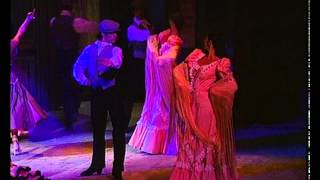
La Verbena de la Paloma , subtitled The Apothecary and the Chulapas and Ill-Repressed Jealousy , is a one-act farce in prose with a libretto by Ricardo de la Vega and music by Tomás Bretón , which premiered on February 17, 1894, at the Teatro Apolo in Madrid . Its title refers to the Madrid festivities around August 15, when the procession of the Virgin of La Paloma takes place. La Verbena consists of a single act, divided into three scenes, and is a prototype of the género chico , a short zarzuela.
Today we offer the choreography of the Prelude to the Zarzuela in the version by the Alhambra Ballet .
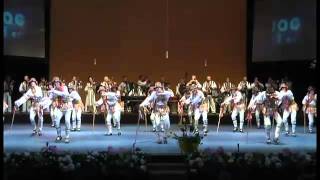
Călușarii . This dance dates back to ancient times when the ancient Kingdom of Dacia existed in place of present-day Romania and the Republic of Moldova . The dance is traditionally performed during the week before Pentecost , but there are records attesting to its practice on other occasions. It was believed that the Călușarii could drive away evil spirits, especially the iele or rusalii (mythical female beings that caused illness). Performed only by men, the dance is characterized by very fast and precise movements, including high jumps, rhythmic footwork, acrobatic steps, and the use of sticks (bâte) and sometimes symbolic swords. The dance had a therapeutic role, as it was believed to heal the sick, and it also strengthened community cohesion and cultural identity. The Căluș ritual was recognized by UNESCO as an Intangible Cultural Heritage of Humanity , due to its antiquity and symbolic complexity.
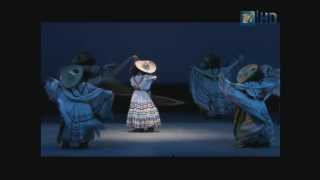
The dance " La Charreada " is a choreography by the Ballet Folklórico de México that depicts the traditions of Charrería , a Mexican national sport. It represents equestrian art and the work of the old haciendas, featuring colorful costumes, mariachi music, and movements that imitate the charro courting his beloved, showcasing gallantry and skill with elements such as rope handling, footwork, and skirt movements; all to the rhythm of the music. Today we present the choreographic piece performed by the Ballet Folklórico de México de Amalia Hernández, accompanied by the Veracruz State Youth Symphony Orchestra (conducted by Antonio Tornero ), as part of the 60th Anniversary Gala at the National Auditorium in Mexico City , January 13, 2013.
Recommended music videos for children





Various Wikipedia articles and relevant information on Artificial Intelligence were used to prepare these texts.
The texts of Videomusicalis are written in Basque, Spanish and English.